Search "brand voice examples" and you'll get the same five companies every single time: Apple, Nike, Mailchimp, Starbucks, and whatever other billion-dollar brand made the listicle that week. Useful if you're running a Fortune 500 marketing department. Pretty useless if you're a one-person business trying to work out how you should actually sound.
The good news is that you don't need to invent a brand voice, and you definitely don't need to borrow one. If you're a service provider, you already have a voice; it's the way you already talk to your people. What you have to do now is notice it, get it down on paper, and start using it on purpose.
So this post does two things. First, it shows you real brand voice examples — a range of them, so you can see there's no single "right" way to sound. Then, the part most articles like this skip: how to find and define your own, the way I actually do it when I write brand voice guides for clients.
What is a brand voice?
Your brand voice is the personality behind your words. It's the consistent through-line in how you write and speak across your website, your emails, your captions, your sales pages — the thing that makes someone recognise you before they've seen your name or your logo.
For a service-based business and other solopreneurs, that voice is mostly just you. The warmth, the opinions, the way you explain things, the jokes you can't help making. When a client says "reading your emails feels like talking to you," that's brand voice doing its job.
Brand voice vs. brand tone (they're not the same thing)
These two get used interchangeably constantly, and mixing them up is one of the fastest ways to end up with copy that feels off.
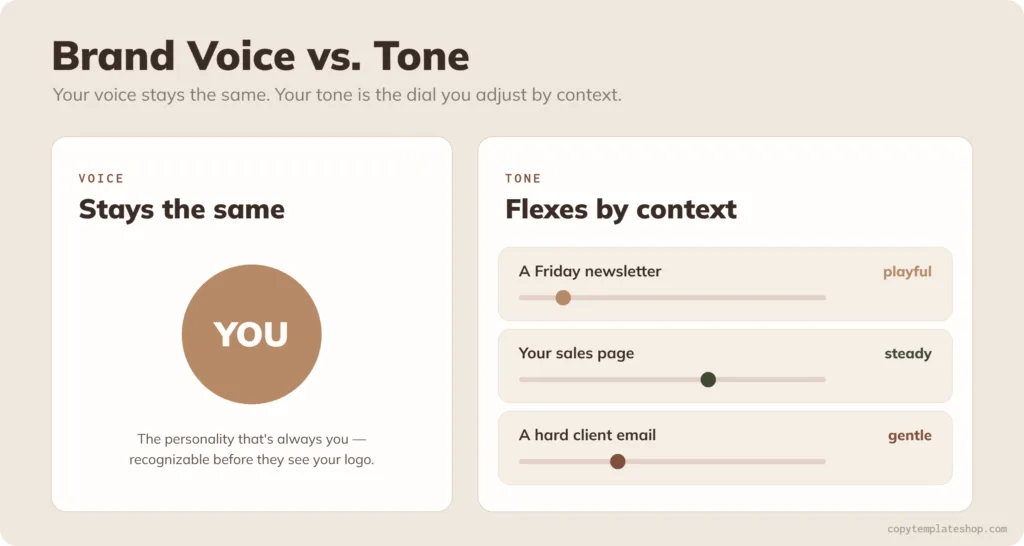
Voice is constant. It's your personality on the page, and it doesn't change based on what you're writing. Tone flexes by context. It's the dial you turn depending on the moment — more playful in a Friday email, steadier on a sales page, gentler in a reply to an overwhelmed client.
Same person, different modes. Think of how you'd talk at a dinner party versus comforting a friend who's having a hard day. Still unmistakably you, just a different setting on the dial. If you ever have to choose, protect the voice. A casual email in your real voice will always land better than a polished sales page that sounds like a stranger wrote it.
Brand voice examples: what different voices actually look like
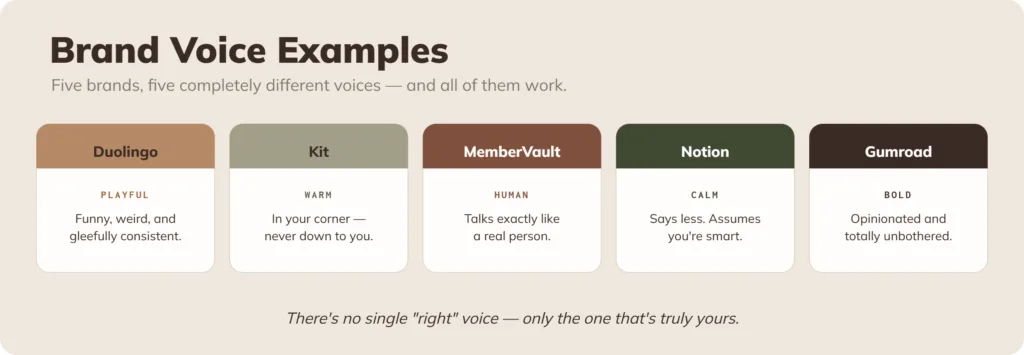
There's no single correct voice, which is exactly why copying one off a list never works. Instead, here are five brands online business owners already know — each sounding completely different, and each doing it well.
| Brand | The voice in a few words | What makes it work |
|---|---|---|
| Duolingo | Playful, chaotic, a little unhinged | Leans all the way into being funny and weird — and it's so consistent it's become the whole personality |
| Kit (formerly ConvertKit) | Warm, encouraging, creator-first | Talks to creators like it's in their corner, never down to them |
| MemberVault | Friendly, human, refreshingly unpolished | Sounds like a real person who'd happily hop on a call — quirks and all |
| Notion | Calm, clean, quietly confident | Says less, assumes you're smart, never oversells |
| Gumroad | Bold, blunt, opinionated | Talks to creators like a no-nonsense insider, takes clear stances, and skips the corporate polish |
Now look at what each of those would mean for a solo service business:
- Playful (à la Duolingo): a brand designer whose emails are full of bad puns, dramatic reactions, and zero corporate polish — because that's genuinely how she is.
- Warm and encouraging (à la Kit): a launch strategist who writes like she's cheering you on from the sidelines, naming the scary feeling before she hands you the plan.
- Friendly and human (à la MemberVault): a VA who writes exactly how she talks, types "ok amazing!!" without overthinking it, and never tries to sound like a Big Agency.
- Calm and minimal (à la Notion): a systems consultant whose copy is spare and unhurried, trusting the reader instead of shouting at them.
- Bold and opinionated (à la Gumroad): a messaging strategist (hi) who'll happily tell you which industry advice is nonsense and why.
Notice that none of these are better than the others. They're just true to the person behind them. That's the part that matters, and it's the part a swipe-from-Nike approach can never give you.
Why you can't just borrow Nike's voice
Here's where I get a little opinionated, because this is the thing I most want you to take from this post.
When you are your business, your brand voice should genuinely be your voice — extracted from the way you already talk to your people. The second you try to bolt on someone else's voice because it worked for them, it starts to turn performative. And performative is impossible to keep up.
Big brands can hand a documented "confident, witty, aspirational" voice to a team of twelve writers and have it come out consistent, because for them the voice is a system. For you, the voice is a person. Trying to perform a personality that isn't yours is exhausting in a way that copying a brand guideline never warns you about.
You can usually spot a performed voice because the person can't stay consistent with it. Their Instagram captions are cheeky and bold, then you click over to their website and it's suddenly buttoned-up and professional. Somewhere along the line, they're performing. They've decided they need to be the fun gal-pal on social to connect, and the Serious Professional on the website to convert — so they're squeezing themselves into boxes based on what everyone else is doing, or what some coach told them they should do.
But the clearest tell of voice performance is one you can feel in your own body. If you have to take a deep breath and get into character before you create any content, that's the sign: you're performing. And it's why staying consistent feels so hard — you're not being yourself, you're doing a bit.
This is also where I see service providers fall into one of two camps:
- The overthinkers. They put so much weight on brand voice that it freezes them. Everything they write feels not-quite-right, so they post less, or they burn out trying to sound a certain way. Often they're obsessing over voice while ignoring the things that matter more — like their messaging strategy and positioning. Brand voice is getting in their way instead of helping.
- The underthinkers. They've quietly outsourced their voice to AI. Chatty McG will pop out a draft and they'll go "yeah, that sounds good, that's compelling" — but when I ask "does it sound like you?", they've got no answer. They're copy-pasting whatever the tool gave them, maybe nudging a word here and there, but not steering it.
Both camps have the same root problem: they don't actually know what their voice is yet. So let's fix that.
How to find your brand voice (extract it, don't invent it)
You're not building a personality from scratch. You're catching the one you already have. Here's the starter version of the process I use.
1. Mine your own words
Pull up the stuff you've written when you weren't trying to sound like a brand — voice notes, the captions you were proud of, an email to a client that just flowed, a Voxer message to a friend. That's your voice in the wild. Read it back and notice what keeps showing up.
2. Clarify who you are and who you're for
Jot down a handful of words that describe you (warm, blunt, nerdy, calm — whatever's true), plus your actual values. Then picture one specific dream client and how you'd talk to her. Voice lives at the overlap of who you are and who you're talking to.
3. Capture it simply — a "Voice Is / Voice Is Not" list
This is more useful than the usual "pick 3 adjectives," because the Is Not column is where the clarity hides. Here's a slice of mine for The Copy Template Shop:
| My Voice Is | My Voice Is Not |
|---|---|
| Warm and conversational — like a friend who happens to know a lot about copy | Corporate, stiff, or trying to sound impressive |
| Opinionated and bold — I'll name what I think is broken about the industry | Preachy or "my way is the only way" |
| An accessible expert — I teach the whole method openly | A gatekeeper hoarding secrets to justify a price |
| Specific and proof-driven — every claim has a number or a real example | Vague or hyperbolic ("skyrocket your results!") |
Then note your signature patterns: the words you reach for (I say "clients" not "customers," I open with "Hey there!" not "Hello"), your punctuation habits, your sign-off, and the words you'd never be caught using. That short reference is your brand voice guide. A page or two you actually use beats a beautiful one you never open.
4. Put it to work (including with AI)
Once it's written down, you can hand it to a copywriter, a VA, or — the big one in 2026 — your AI tool. A documented voice completely changes what you get back from ChatGPT or Claude.
Without it, you get generic AI cadence, and your readers can smell it. They'll open your newsletter, clock that you let a robot write it, and not bother — because why would they read something you didn't care enough to write?
With a voice brief, you still edit, but the tweaks are fewer and more intentional. Better yet, because you finally know what your voice is, you can spot the line that's off and tell the AI "rewrite this in my voice" — and now it actually knows what you mean. (More on that in my post on using AI for copywriting.)
Find your voice as part of your bigger message
Brand voice is one piece of your messaging, not the whole thing. It has to work alongside your positioning and your overall message for your content to feel easy to create, sound like you, and stand out.
That's exactly what the Messaging Clarity Journal is built for. It walks you through developing a deeper understanding of your messaging — brand voice included — so you stop second-guessing how to show up and start writing content that actually feels like you. If you've been stuck in the overthinking camp, this is the way out.
(And if you'd rather get expert eyes on the whole thing, hiring a messaging strategist and consultant is always an option too.)
Frequently asked questions
What are the different types of brand voice?
There's no official list — voice exists on a spectrum, not in fixed buckets. Common directions include playful (Duolingo), warm and encouraging (Kit), calm and minimal (Notion), and bold and opinionated (Gumroad). The goal isn't to pick a type off a shelf; it's to find the version that's genuinely yours.
How do I describe my brand voice in three words?
Pick words that are true to you and that you could defend with examples — not just flattering adjectives. "Warm, blunt, funny" is more useful than "professional, innovative, trustworthy." Then pressure-test them: does your last email prove those words?
Can a one-person business even have a brand voice?
Yes — and you've got an advantage a big company doesn't. Your voice is just you, so you don't have to manufacture a personality or keep a committee consistent. The work is noticing how you already talk and doing it on purpose.
What's the difference between brand voice and tone?
Voice is constant; it's your personality on the page. Tone flexes by context — more upbeat in a launch email, steadier on a sales page, gentler in a hard conversation. If you have to choose, protect the voice.
How do I keep my brand voice consistent — and brief AI with it?
Write it down: a short "Voice Is / Voice Is Not" list plus your signature words and patterns. Use that same reference everywhere, and paste it into ChatGPT or Claude before you ask for a draft.
Looking for more copy tips?
- How to Write Website Copy That Converts
- How to update website content: a step-by-step guide for business owners
- SEO for Service Based Business: How to Actually Get Found
- 4 Top Instagram Caption Types for Entrepreneurs
Pin for later