Most service providers get really nervous when it comes time to write their website copy because they don’t really know how to talk about themselves without sounding like they’re either bragging or apologizing for existing. The really good news is that the best website copy doesn’t actually talk about you all that much anyway.
Yes, your reader needs to know who you are, what you do, and why they should believe you can do it well, and there are certain things about you and your business that absolutely need to live on the page. But the websites that actually book clients are the ones where the reader feels seen and heard before they read a single thing about the person behind the brand.
If you’re a service provider, coach, or consultant — and you’re probably in this work because you genuinely care about the people you help — the fastest way to start writing website copy that converts is to take yourself out of the equation for a minute and start with copy that’s about your reader. Treat the first draft like you’re literally just having a conversation with that person. That’s connection, and it’s what makes the rest of your website actually work — the credentials, the testimonials, the pricing, the CTAs — once it’s in place.
This guide walks you through how to write website copy that converts, from the strategy work that has to happen before you open a blank page, to the page-by-page writing, to the editing pass that makes your words finally land.

What Is Website Copy (and Why Most of It Doesn’t Convert)?
Website copy is every word on your site that’s selling something — even when it doesn’t look like it’s selling. Your homepage hero, your about page intro, your services descriptions, your CTAs, your footer microcopy, your 404 page. All of it is copy, and all of it is doing a sales job whether you wrote it that way or not.
Most service providers’ website copy underperforms because it’s written from the inside, not the outside — from what the business does, instead of what the reader is trying to figure out. Take this homepage hero:
❌ Bad homepage hero: “I empower busy women to get more done.”
There’s nothing technically wrong with that line, but I’m not learning anything about you, and I’m definitely not getting that “oh my gosh, I have finally landed in the right place” moment that makes me stay on your site. It could belong to a productivity app, a health coach, a virtual assistant, an executive coach, or literally anyone.
Compare it to what the same fractional COO could say if she wrote from the outside in:
✅ Better homepage hero: “I take busy work off the plates of high-achieving women so they can focus on the tasks that actually require their direct input.”
Now I know exactly what she does, who she does it for, and why I’d want to keep reading — and that’s the difference connection-first copy makes.
What to Figure Out Before You Write a Single Word
If you’ve ever sat down to write your homepage and immediately found yourself organizing your sock drawer instead, this is why. The “I’ve been staring at this homepage for three weeks” energy isn’t a willpower problem — it’s a strategy problem. You can’t write copy when you don’t yet know what you’re trying to say, who you’re saying it to, or what makes you the right person to say it. So before you open a blank page, get the strategy work out of the way and the writing gets dramatically easier.
Three things need to be locked in before you write anything:
1. Who you’re writing to. Not your generic “ideal client avatar” with a name and a fake stock photo — the real person you want filling out your inquiry form. What are they Googling at midnight? What did they try before this? What are they afraid will happen if they pick the wrong service provider? You can build this out properly with an ideal client avatar exercise if you don’t have one yet.
2. What you want them to feel and what you want them to do. Both, in that order. The action you want (book a call, fill out an inquiry form, grab a freebie, email you) is downstream of the feeling. Nail the feeling and the action follows. Skip the feeling and even the most beautifully designed CTA button just sits there.
3. What makes you genuinely different — and not in a deliverables sense. This is where most service providers get tripped up. They differentiate based on what’s included in their packages — number of revisions, number of calls, what they will and won’t deliver — and when you differentiate that way, your potential client just goes and looks at the checklist of what’s included for your different packages and makes their decision based on what’s on the list.
If you want to charge higher prices and work with really good clients, you need to be differentiating on the outcome. “This package helps you get X result.” “This package helps you get Y result.” That’s what helps your client understand which of your services is actually the best fit for them. It also positions you as an expert — because you’re selling outcomes, not deliverables.
If you want to go deeper on this before you write, start with a brand messaging strategy. It’s the work that turns “I’ve been rewriting my homepage for a month” into “I drafted my whole site this weekend.”
The Connection-First Framework: How to Write Website Copy That Actually Converts
Once your strategy is locked in, the actual writing follows a clear sequence. I call it the Connection-First Framework, and it’s the pattern that runs through every page of a website that converts:
- Connect first. Make the reader feel seen and heard before you make a single claim about yourself. Show them you understand exactly where they are right now and exactly what they want next.
- Build trust second. This is where your credentials, expertise, and authority finally get to do their work. Show that you actually understand the job using specifics, real outcomes, and the language your client uses to describe what they want — and then back it up with the proof that you’re capable of delivering it. Think case studies, real results, testimonials, your years of experience, and the methodology that makes your work yours.
- Ask for the sale third. Once connection and trust are in place, the ask is the easy part. The CTA isn’t doing all the work — it’s just the natural next step.
Most website copy advice gets the order wrong. It teaches you to lead with credentials, lead with features, lead with the offer. But the order in which you give a reader information is what separates a website that converts from a website that just sits there.
Here’s what it looks like in practice:
| Conversion-first copy (most common) | Connection-first copy | |
|---|---|---|
| Opens with | What the business does | What the reader is dealing with |
| Voice | The brand’s voice | The reader’s voice |
| First impression | “Look how qualified I am” | “I get exactly what you’re going through” |
| CTA energy | “Buy now / Book now” | “Here’s what to do next” |
Both approaches can mention the same offer, list the same features, and even use similar CTAs. The difference is the order in which the reader meets that information — and the order changes whether they keep reading or close the tab.
Page-by-Page: What to Write on Every Page of Your Website
Every page on your website has a different job. Here’s what each one is actually doing — and how to write it so it does that job well.
Homepage
Your homepage has about five seconds to answer two questions for the person who just landed there: “Am I in the right place?” and “Should I keep reading?”
Lead with what your reader is dealing with, who you help, and the outcome you get them. The credentials, the years-in-business, and the awards can all come further down the page — they matter, but they don’t matter first.
Here’s another example, this time for a tech VA who works with online course creators:
❌ Bad tech VA homepage: “Tech support for online businesses — your back-end made easy.”
It’s clean, but it doesn’t tell me who you serve, what you actually fix, or why I’d pick you over the dozen other tech VAs in my Slack groups.
✅ Better tech VA homepage: “I’m the tech VA online course creators trust to handle their funnels, integrations, and launches — so the systems that are supposed to run automatically actually do.”
If your homepage hero could belong to anyone in your industry, rewrite it. Specificity is what makes it yours.
For the full breakdown, the homepage copywriting guide walks through it section by section.

About Page
The about page is the hardest page on your website. It’s also the one that gets botched most often, because nobody really teaches you how to write one that doesn’t sound like a glorified resume.
The biggest mistake on about pages is leading with how long you’ve been passionate about your craft.
❌ Bad about page opener: “I have a passion for design. I’ve had a passion for design since I was a young age.”
Honestly, nobody cares that you’ve been designing since you were ten — at least not right away. That’s something that can come later. What they need to know first is why you’re a designer now, why this particular niche, why you want to help them, and what you’re actually going to help them achieve.
✅ Better about page opener: “If your website still looks like the Showit template you tweaked at midnight three years ago and you’re starting to feel weird sending people there, you’re in good company. I’m a brand and web designer for established service providers who are ready for their site to finally match the work they’re actually doing now — and the rates they’re actually charging.”
That opener does the connection work first (you know exactly who she’s talking to, and you’ve already nodded twice), and only then does it signal expertise — without rattling off a list of credentials. The “I’ve been passionate about design since I was a kid” stuff can show up further down the page, once she’s earned the right to talk about herself. For the full structure, see how to write an about page.
Services / Sales Pages
Your services page is where outcome-based differentiation does the heaviest lifting. It’s also where jargon does the most damage.
❌ Bad jargon-heavy services description: “A 3-month holistic experience to reshape your relationship to internal friction, so you can personalize your self-leadership and enhance inner congruence.”
Depending on who you’re talking to, your potential client may have no idea what “internal friction” or “self-leadership” or “inner congruence” actually means. They might know they feel stuck, they might know they’re avoiding the things they say they want to do, they might know they second-guess every decision — that’s the language to use.
✅ Better services description: “A 3-month one-on-one container for the high-achieving woman who’s tired of overthinking every decision, second-guessing the things she actually wants, and waking up at 3am to mentally re-litigate yesterday’s conversations. By the end, you’ll know what you want, you’ll have the language to ask for it, and you’ll stop outsourcing your decisions to other people’s opinions.”
It’s the same offer, but the second version is written in the client’s language instead of the coach’s, and it differentiates by outcome (“you’ll stop outsourcing your decisions”) rather than by deliverable (“3-month container, six sessions, two emergency texts”).
Write your services the way your client would describe what’s going on with them — in their day-to-day life, to a friend — not the way you’d describe it to a peer in your industry. And then differentiate your packages by outcome, not deliverables. “Six 90-minute sessions” is what they get. “By the end of this, you’ll stop second-guessing every decision” is what they’re paying for.
Contact Page (and Why You Probably Need More Than One CTA)
A contact page with only an inquiry form is one of the quickest ways to lose leads, especially if you sell anything that requires a bit of trust-building first.
Some people landing on your site are ready to inquire today, but most of them aren’t. They’re researching, comparing, and deciding, and if your only CTA is a contact form, you’re giving them nothing to do that isn’t a hard commitment.
Multiple CTAs across your site (and on your contact page specifically) catch people at different stages of “I might want to work with this person”:
- A lead magnet for the people who want to learn more before reaching out
- An email signup for the people who want to stay in your world
- Your inquiry form for the ready-to-inquire crowd
- A different async option (email, a Booker link, a “follow me on [platform]” — whatever fits) for the people who don’t love forms
You don’t need all of them on every page, but you do need more than one across your site.
Stop Overthinking Brand Voice (Write It Boring First)
I want to talk about brand voice for a minute, because most people are putting way too much emphasis on it when they’re drafting their website copy, and that’s exactly what’s getting in their way of actually publishing anything.
Brand voice is important. It’s important to know what your brand voice is, and it’s important to write copy that feels like you. But a lot of the time, when people teach brand voice, what they’re actually teaching is personality — and it makes us feel like we have to force a personality into our written copy that we don’t actually have. We don’t actually talk that way.
You get caught up trying to be:
- Fun
- Clever
- The kind of brand that “stands out”
And it makes it twenty times harder to write anything half decent, because you’re trying to push yourself out of your comfort zone before you’ve even said the thing you’re trying to say.
💡 Write it boring first. Get the words down in the clearest, plainest language you can manage, and trust that you can always go back and add the voice later — the fun examples, the anecdotes, the asides. Get the substance down first.
What does your reader actually need to know to feel connected to you? What actually has to come across about your offer for them to think it’s interesting and want to reach out? Answer those two questions in the plainest possible language, and your first draft is done.
One last thing about brand voice. What actually makes a brand voice appealing to your ideal client is reflecting their own language back to them — and the more you can do that, the better your copy gets, without you having to invent a single “punchy” line.
The Editing Pass Most People Skip
The editing pass is where website copy actually gets good. The first draft just gets the words on the page — usually with way too many of them, usually too generic, and usually accidentally written in your voice instead of your reader’s. The second pass is where you cut the empty phrases, swap the generic for the specific, and make sure your copy is doing the connecting it’s supposed to do.
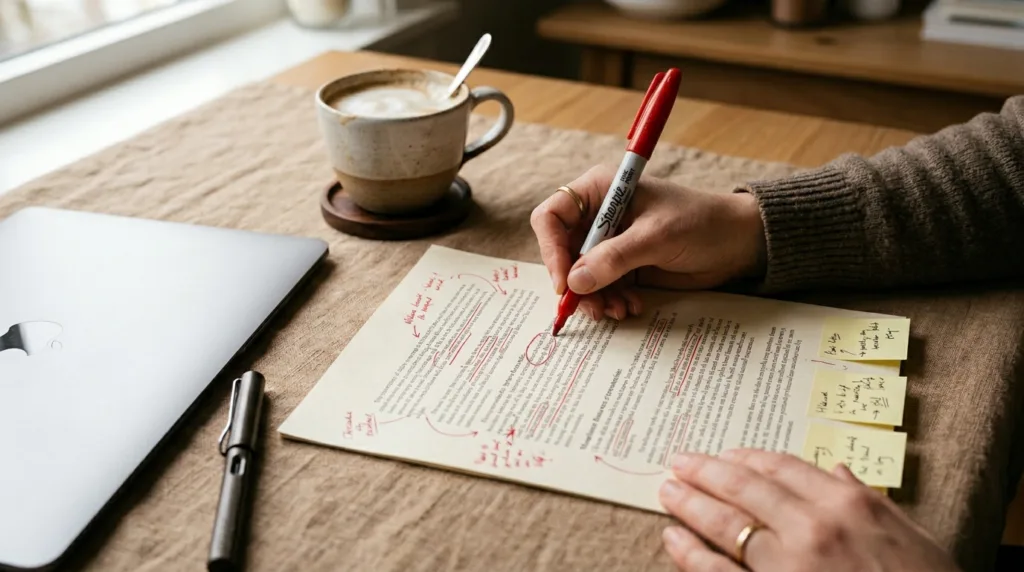
This is also the part most people skip, usually because they’re so relieved to have a draft that hitting publish feels like the finish line. So before you hit publish, run through this checklist:
- Read it out loud. If it doesn’t sound like you (or like the client, if you’re writing for one), it gets tweaked or scrapped. Reading it out loud is the only test that catches the stuff your eyes will let slide right past.
- Hunt for empty copy. Is any of this language not holding its weight? Are you using generic phrases where a specific swap would land harder? Something like “helps you grow your business” is empty, but “helps you book three new clients in your first month” actually means something.
- Check whose language you’re using. The copy needs to be in your ideal client’s language, not yours. Describe outcomes the way they’d describe their desires, and describe pain points the way they’d describe their problem — not what you, the expert, believe the problem to be, but what they’re actually saying.
- Final jargon sweep. If anything snuck through that they wouldn’t say at a dinner party, rewrite it.
This is the difference between copy that’s technically fine and copy that converts.
A Real Example of Connection-First Copy In Action
A podcast management agency I worked with used to grind for every single sale, doing tons of sales calls to close their packages, with most of those calls doing the work that the website should have been doing in the first place.
After we redid their website with connection-first copy — strategic page planning, outcome-based services, and language that sounded like their client instead of the agency — they started booking $8,000 packages straight from website traffic, from fairly lukewarm leads who’d landed there from Google or referrals, with no sales calls required. And this isn’t a one-off result either; I’ve watched it happen over and over with service providers and agencies who actually put the work into their website copy.
When you’re a service provider, you’re in a fairly unique position, because by the time someone lands on your site, they’re probably already product-aware. They know they want to hire someone like you, and they’re comparing you to other people who do similar work, which means your website copy’s only real job is to make the buying decision easy for them. If you can make them feel seen, heard, and understood, you remove most of the friction from the buying journey — and you no longer need to have the same complicated sales conversation on every single call.
Want a Website That Does the Selling For You?
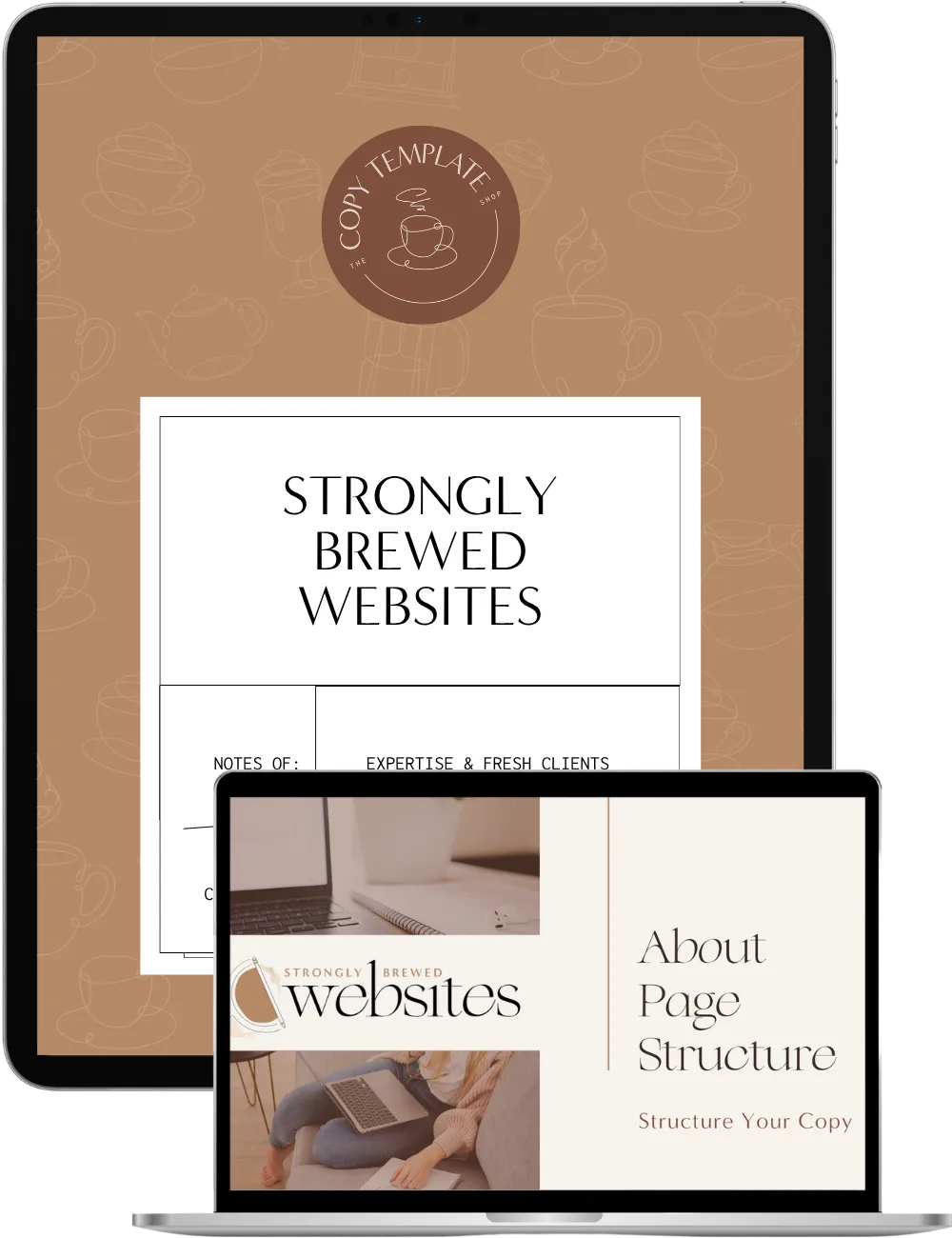
If you’re ready to write a website that books clients while you’re doing the actual work — instead of one that sends every lead to a discovery call — Strongly Brewed Websites walks you through the entire Connection-First Framework above. You’ll lock in the strategy first, then write your homepage, about page, services pages, and contact page using the templates and page-by-page guidance inside, then run the same editing pass I run every client project through before it goes live.
By the end of the course, you’ll have a finished website written in your reader’s language — and the skills to update or rewrite it whenever your offers evolve.
Frequently Asked Questions
How long should website copy be?
Long enough to do the page’s job, and not a word longer. A homepage hero might be 12 words. An about page might run 800. A services page or sales page can stretch past 2,000 if the offer needs that much explanation. The right length is whatever it takes to connect with the reader, build trust, and ask for the action — without padding.
What’s the difference between website copy and website content?
Copy is selling something. Content is informing or educating. Your homepage, about page, services pages, and sales pages are copy — every word is doing a sales job. Your blog posts, free guides, and resource pages are content — they exist to teach, attract organic traffic, and build trust. Most websites need both, but they get written differently.
How do I write website copy that ranks on Google?
Start with the right keyword for each page (one per page, not one across the whole site). Write the page for the human first — Google now prefers copy that actually answers the searcher’s question. Then make sure the basics are in place: keyword in your H1 and meta description, descriptive H2s, internal links to related pages on your site, and image alt text. If you want to go deeper on writing service pages that actually rank and bring in inquiries, Clients From SEO walks through the full SEO-for-service-providers approach.
How long does it take to write website copy?
Faster than you think if your strategy is locked in first. The actual writing of a five-page website (home, about, services, contact, plus one more) typically takes a few focused days of drafting and a few more for the editing pass. Most of the time people lose on website copy is the time spent staring at a blank page because the strategy work hasn’t happened yet.
Can I use AI to write my website copy?
You can use AI to draft, brainstorm, and reformat — but it can’t make the strategic decisions that make copy convert. AI doesn’t know your client’s exact language, your offer’s actual differentiator, or what makes someone trust you specifically. Use it as a drafting tool, not a strategist. And always run an editing pass that puts the copy back in your reader’s voice, not the AI’s.
Ready to Stop Staring at That Blank Homepage?
The best website copy is the one that’s actually finished and live on the internet, and the fastest way to get there is to pick one page, write it boring first in the plainest language you can manage, and come back later to add the voice.
Already have a website that has gone a little stale? Here is how to update your website content instead of writing from scratch.
What’s Next?
Pick the option that fits where you are right now:
- Just want a starting point? Grab the free Website Copy Roadmap — it walks you through what each page on your site needs to do, so you have a plan before you open the blank page.
- Want templates to skip the blank page entirely? The Copy Template Shop website content templates give you fill-in-the-blank structures for your homepage, about page, services pages, and more. Use them as the scaffolding, then add your voice.
- Ready to write the whole thing properly? Strongly Brewed Websites is the full course. The Connection-First Framework, page-by-page guidance, the editing process, and templates all baked in.