You open ChatGPT, type "write me a sales page for my course," and hit enter. Thirty seconds later, you've got… something. It's polished. It's grammatically perfect. But it also sounds like every other sales page on the internet.
Swapping to another AI tool isn't going to fix this problem, because AI isn't the reason your copy sounds generic. Skipping the strategic work is.
If you've been trying to figure out how to use AI for copywriting without sounding like everyone else, it's time to stop comparing models or following random prompts you found on Threads. AI copywriting (using tools like ChatGPT or Claude to help draft and refine your marketing copy) can save you serious time and give you some decent copy to work with — once you know what it's actually good at and what it absolutely isn't.
Let me show you what to hand over to AI, what to keep for yourself, and how to get drafts that still sound like you.
Why does AI-generated copy all sound the same?

When we talk about using AI for copywriting, we're really talking about Large Language Models, or LLMs. And an LLM tool's whole job is to predict the most likely next word. The issue, then, is that the most likely next word is rarely (never) the most distinctive one. That's not a knock on the technology — it's just how it actually works.
This is exactly why, whenever you ask AI for a sales page, a social media caption, a blog post, whatever, what comes back is workable. Technically correct, professional, true for the masses, yet completely interchangeable with what the next person gets when they type a similar prompt. Competent, inoffensive, and just a little bit beige.
These AI tools have been trained on what most people have already written, which naturally means it's going to spit out something that sounds like what most people have already written.
And no, better prompts don't fix this on their own. The quality of what comes out depends almost entirely on the context you feed in alongside the prompt. AI defaults to the average, so your job — if you actually want copy that sounds like you and stands out in a sea of sameness — is to refuse the average. Everything below is how you do that.
The real reason your AI copy isn't working: you're asking it to decide, not draft

Most people use AI for copywriting in one of two ways, and both hand it a decision it can't actually make.
The first is writing from scratch. You open ChatGPT, say "write me a sales page for this," paste in your offer name, price and deliverables, and hit go. The trouble is you haven't given it any direction on the types of things a copywriter would consider when writing your sales page, like sales psychology, the buying journey, or even which sections a sales page for this particular offer even needs. And AI can only consider what it's prompted to consider; if the strategy isn't in the input, it can't be in the output.
The second is asking AI to "fix" copy you already have. You paste your About page in, say "make this better," and hit go. AI is genuinely good at this; ask it for something "better" and it'll always hand you back something cleaner, tighter, more "dialed in." But it also strips out a lot of the you, because when you say "make it better" without saying what to fix, it makes those calls based on what "better" copy usually looks like according to best practices — aka the average. What gets sanded off is the part that sounded like a person.
Both moves treat AI like a strategist, and it isn't one. The most useful way to think about it is as a fast, capable junior copywriter — or honestly, a really good typist. Chatty McG types quick, but she does not strategize. AI executes beautifully once you've made the decisions. But as long as you keep asking it to make the decisions for you, you're going to keep getting average, same-y outputs.
How to use AI for copywriting in 6 steps (without losing your voice)
The fix isn't "use AI less" or "use AI more"; it's doing the strategic work first, then letting AI do the heavy lifting on everything downstream. Here's the step by step system that keeps your voice and unique positioning intact.
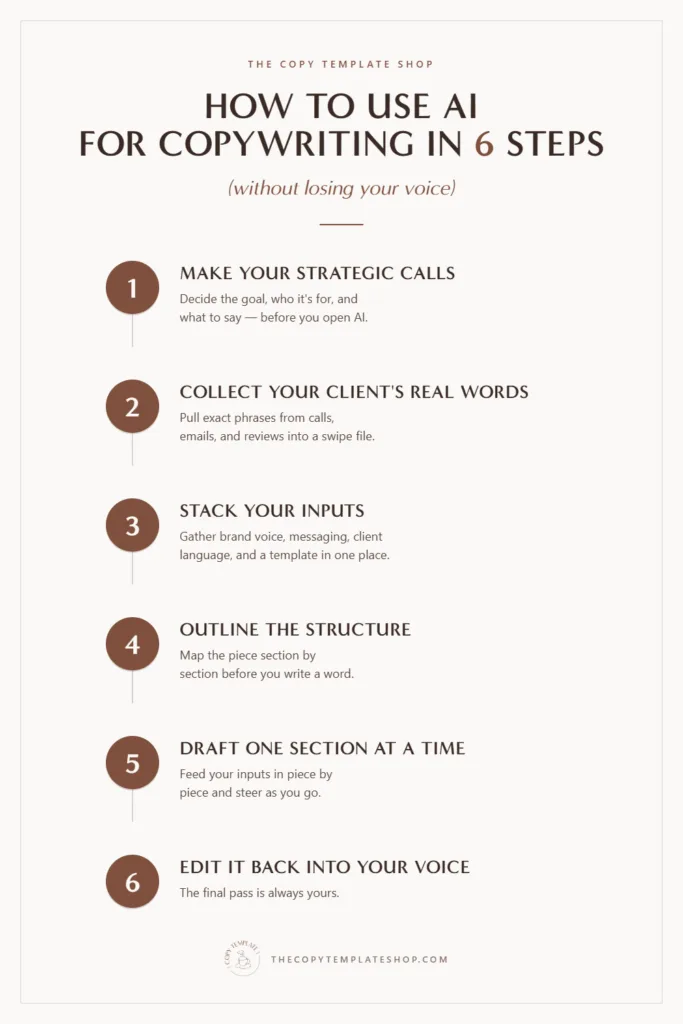
Step 1: Make your strategic calls before you open ChatGPT
Decide the one thing this piece of copy needs to do, exactly who it's for, and what you actually want it to say. Not simply "this sales page has to sell my course to busy moms". Dig deeper. What's their stage of awareness? Are they warm or cold? What does their decision-making process look like? What do they need to know about my offer to be ready to buy?
AI can't make these calls. It doesn't know your business model, your sales process, or your buyer. You can use it to pressure-test a decision you've already made ("here's my primary goal — what's the strongest argument against this being my main CTA?"), but the decision making has to be yours. Not only will you get stronger, more specific copy as a result, but your copy will be far more likely to convert.
Step 2: Collect your client's real words
AI doesn't know your clients; it knows averages. So before you draft, go pull the exact phrases your clients actually use — from sales call notes, offboarding forms, your last five client emails, book reviews in your niche, whatever. Copy them down word for word and throw them into a swipe file. (These customer pain point questions are a good way to surface that language if you don't have it yet.)
This is the raw material that makes copy feel like you read the reader's mind — and it's the one thing AI can't manufacture.
Step 3: Stack your inputs
This is the step that does the most heavy lifting, and it's the one almost everyone skips. Before you ask AI to write a single line, gather everything that makes your copy yours into one place: the strategic decisions from steps 1 and 2, your brand voice notes, your core messaging, your client-language swipe file, and a proven template for the kind of thing you're writing.
Hand AI a bare prompt and it pulls from the average. Hand it your stacked inputs and it pulls from you — it stops guessing and starts assembling the strategy you already set. It's the difference between asking a stranger to describe your business and asking your favourite long-time client to.
Step 4: Outline the structure before you write a word
No matter what it is that you're writing — a blog post, a sales page, a page for your website — start by mapping the piece section by section. What, exactly, does the reader need to know and in what order? (Our offer-specific sales page templates take the guesswork out of this for you.)
Then, for each section, write one line about what it needs to do for the reader. If you can get this point right, you're giving the AI tool a solid direction to work with.
AI is a decent thinking partner for the zoomed-out flow, but it's genuinely bad at structuring a specific page based on a unique buying journey. A $97 mini-offer and a $5,000 service don't get the same sales page structure, yet AI tools tend to give both situations the same generic flow. Bring the structure yourself — from your own experience and copywriting knowledge, or a template built for your exact kind of page — then let AI stress-test it.
Step 5: Draft one section at a time
Now — and only now — you actually draft. Don't ask for a whole page in one go; you'll either accept the average draft or rewrite half of it, which defeats the point. Instead, ask for one section at a time, feeding in the relevant slice of your stacked inputs with each request. Working section by section keeps you in the driver's seat: you can steer, reject, and redirect before the next piece, instead of wrestling one giant generic draft into shape after the fact.
Step 6: Edit it back into your own voice
If you really want your AI copywriting to sound like you, the one rule to always follow is that the last pass is always yours. Before publishing anything, you get the final say. The good news is that at this point you're basically just copyediting for a voice check, not copywriting from scratch.
Look over the draft with a keen eye and put back the specific details, the asides, the uniquely-you turn of phrase AI smoothed out. This is where the copy stops sounding capable-but-anonymous and starts sounding like you.
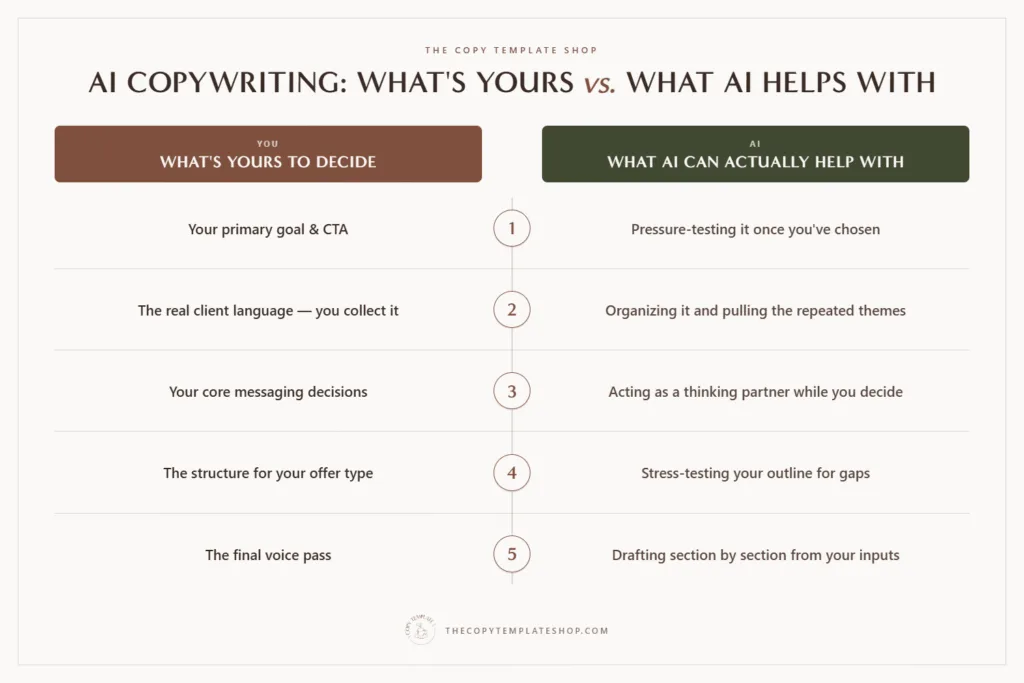
Want a cheat sheet for this process? Here's the whole thing at a glance:
| What's yours to decide | What AI can actually help with |
|---|---|
| Your primary goal / CTA | Pressure-testing it once you've chosen |
| The real client language (you collect it) | Organizing it and pulling the repeated themes |
| Your core messaging decisions | Acting as a thinking partner while you make them |
| The structure for your type of offer | Stress-testing your outline for gaps |
| The final voice pass | Drafting section by section from your inputs |
The commonality across all steps: most of what AI does here is supporting, not deciding. The moment you let it make a strategic call for you, it hands back exactly what it's best at producing — average. So: AI drafts, you decide, section by section.
What using AI for copywriting actually looks like
All of this is nice and easy in theory, but let me show you the difference with real before-and-afters — the generic version AI generates on its own, versus what's possible once a human has done the research and made the decisions before asking AI to lend a helping hand.
A VA for mom entrepreneurs. Here's the AI default, with no research behind it:
"I help busy moms reclaim their time by handling the day-to-day admin of their business."
And here's what AI can generate once you've actually listened to how your clients talk:
"I help mom entrepreneurs stop checking Slack at the breakfast table. I take the inbox, the calendar, the client onboarding follow-ups — so you can actually be present at the school pickup."
The first one isn't wrong; it's just invisible. "Reclaim your time" is an abstract benefit every VA on the internet promises. The second names a specific, sensory moment the reader recognizes from her own life — and you can only write that if you've heard a real client say it. The specificity is the whole difference, and it came from research, not a cleverer prompt.

A web designer explaining why-you. The AI default:
"I'm passionate about web design."
Versus a version with an actual point of view:
"I eat, live, and breathe web design. All the podcasts I listen to? Web design. All the books I read? Web design. I'm constantly honing my craft so my clients get sites that convert, not just sites that look pretty."
"I'm passionate" is the most-said sentence on the internet; it tells the reader nothing because everyone claims it. The second example doesn't say passionate — it proves it with specifics, then ties that obsession to something the client actually wants (sites that convert). It shows instead of tells, which AI won't know to do unless you hand it the evidence.
A coach building authority. The generic move is to list credentials:
"I've worked with hundreds of clients over my 10-year career."
The version that lands authority and connection:
"I've spent 10 years coaching corporate leaders who were burning out behind closed office doors. I've sat with them as they wrote their resignation letters. I know what this version of you is afraid to say out loud — because I've heard it before."
The first builds authority, but it's all about the coach. The second keeps the credential (10 years) and turns it toward the reader's inner experience — the thing she's afraid to say out loud. That's what makes someone feel seen, and it only exists because the coach knows precisely who she serves and what they're carrying (and gave that information to the AI).
A brand strategist naming who she serves. AI reaches for the widest possible net:
"I help female entrepreneurs scale their business."
A human narrows it until it's unmistakable:
"I help wellness solopreneurs whose offers are working, but whose brand identity hasn't caught up with where the business is now."
"Female entrepreneurs" is so broad it repels no one and attracts no one. The second describes a specific person at a specific moment, so the right reader feels personally called out — and the wrong-fit reader self-selects out, which is exactly what good positioning should do.
Notice the pattern: in every pair, the better version isn't more clever or more "branded." It's more specific — because a person fed in something AI never had: real client language, a real point of view, a real decision about who this is for. That specificity is the thing you can't prompt your way to. You have to bring it. (If you want help making those decisions before you ever open a doc, the Messaging Clarity Journal walks you through them.)
Want the exact prompts I use?
If this clicked and you want the actual workflow — what to do before you prompt a single word, how to train AI on your voice so it sounds like you, and the section-by-section prompts that get usable first drafts — I put all of it in a free guide.
Grab the free AI Prompts for Sales Page Copywriting →
It's the directing-and-refining part most people skip, written out step by step.
Frequently asked questions about using AI for copywriting
What is AI copywriting? AI copywriting is using artificial intelligence tools like ChatGPT or Claude to help write marketing copy — sales pages, emails, website content, social posts. Used well, it's a drafting and organizing tool that speeds up your process. It works best when you bring the strategy and let AI handle the execution, not the other way around.
Why does AI-generated copy sound so generic? Because AI predicts the most likely next word, and the most likely word is rarely the most distinctive one. It's trained on the average of everything already written, so left to its own devices it defaults to what everyone else has already written. The fix is feeding it specific context — your client's real language, your actual point of view — so it has something better than the average to work with.
Can AI replace copywriters? Not for the work that matters most. AI drafts fast and follows best practices, but it can't make the strategic decisions — who you serve, what makes you different, what your reader actually needs to hear — that make copy convert. It's a strong execution tool and a weak strategist. If you'd rather have that strategic work done for you, hiring a professional, well-trained copywriter who knows brand strategy is still the move.
Is it bad to use AI for copywriting? No, and I'm not going to shame anyone out of using it. What causes problems is handing it the strategic decisions instead of the execution. Keep AI in a supporting role — organizing research, drafting from your inputs, pressure-testing your choices — and it saves you real time without flattening your voice.
What's the best way to prompt AI to write copy? Two things make the biggest difference: draft section by section instead of asking for a whole page at once, and stack your inputs — feed in your messaging, your structure, your real client language, and your voice notes alongside the request. The more strategic context you provide, the less generic the draft.
The bottom line
AI is a brilliant tool for drafting, organizing, and moving faster; it's just not a substitute for the strategic work that makes copy sound like you and actually convert. Do the strategic work first, keep AI doing the jobs it's good at, and you get the best of both: copy written in a fraction of the time that still sounds unmistakably human.