Most of the "should I DIY my website copy?" content out there is written by someone who either wants to sell you their copywriting services, or wants to sell you a shortcut. Which means the answer is almost always skewed in one direction or another.
I'm a professional copywriter. I've written website copy for dozens of online service providers, and I also teach people how to write their own in Strongly Brewed Websites. So I genuinely sit on both sides of this fence — which is exactly why I think I can give you an honest answer.
Here it is: in most cases, you should write your own website copy. Especially if you're an online service provider who's still building, still evolving, or still figuring things out.
That might sound like a weird thing for a copywriter to say. But stick with me.
If you want to hear me talk about this rather than read this blog post, check out the podcast episode below.
What It Actually Costs to Hire a Website Copywriter
Before we get into the "should you DIY" conversation, let's talk numbers, because I think a lot of people either wildly overestimate or wildly underestimate what professional website copy costs.
Working with me for website copy starts at $5,000 USD. Any copywriter who's genuinely experienced — someone who'll do the market research, develop your full messaging strategy, and write copy that actually converts — you're looking at several thousands of dollars at minimum. Experienced website copywriters typically charge anywhere from $3,000 to $10,000+ for a full package. On platforms like Upwork or Fiverr, you can find lower rates, but the quality and the strategic depth vary a lot.
That's a real number. And for a lot of online service providers — especially those who are still building their audience, testing their offers, or planning to make any kind of change to their business in the next 6 to 18 months — it's not the right investment right now.
Here's the part that stings: if you spend thousands on professional website copy and then change your niche, add a new offer, or shift how you work with clients six months later, that copy no longer serves you. And if you've never learned to write your own copy, you won't have the skills to update it yourself. You're back to square one — or back to hiring someone.
So, Who Gets the Best Results from DIYing?
You're in a great position to write your own website copy if:
✅ You have at least some clarity on what you want to offer. You don't need to have every single detail figured out, but if you have a rough sense of who you help and what you do, you're already in a great place. (And if you're not quite there yet, tools like Strongly Brewed Websites actually help you work through that — so you're not starting from zero.)
✅ You're brand new to business. As long as you have a plan and know broadly what you want to offer, you can absolutely write your own website copy. You don't need years of client experience first.
✅ You're in any stage of business where things could still change. If there's any chance you'll be tweaking your offers, shifting your audience, or pivoting your positioning in the next year or two, DIY is the smarter move.
✅ You want to sharpen your copywriting skills. Nothing builds your copywriting instincts faster than actually learning to write your own website copy the right way — doing the market research, developing your messaging, and understanding the principles behind every section. Even if you outsource your copy later, you'll be a much better client because of it. You'll know what to ask for, what to push back on, and what "good" actually looks like.
When Does It Actually Make Sense to Hire Someone?
There are two real scenarios where outsourcing makes sense.
The first is a genuine time problem. DIYing your website copy takes time — realistically, an hour or so a day for a couple of weeks, depending on how you go about it. There are resources that make the process much faster (hi, Strongly Brewed Websites), but it's never zero time. If you're running a full business, working with clients, and truly cannot carve out even an hour a day for a couple of weeks, outsourcing might be the right call.
The second is when you're fully locked in. I'm talking: you've had your signature offers for years, you know exactly who your audience is, your thought leadership is developed, and you are not planning any significant business changes. In that case, investing in a professional who can distill all of that expertise into exceptional website copy is genuinely worth it. What you get isn't just copy — it's messaging strategy and positioning clarity that you can use across your entire business. But you need to be really, really sure before you spend thousands on that. (If that's where you're at, you can learn more about working with me.)
The Hardest Parts of DIYing — and What Actually Helps
Okay, so you've decided to write your own website copy. Here's what I want you to know going in.
The hardest part isn't the writing. It's the decision-making.
Does this sound familiar? You sit down to write your about page and suddenly you're asking yourself: How long does this need to be? Do I need to list my credentials? How personal is too personal? And then somehow you've spent two hours overthinking and written exactly zero words.
That's not a writing problem. That's a decision problem.
When you're writing your website copy, you end up making a surprising number of big decisions all at once. What goes on your homepage? How many service pages do you actually need? What's your call to action — do you want a discovery call, an inquiry form, or a direct booking link? What does your contact page even need to say? Do you need a sales page for each individual service?
A lot of people are surprised to find that writing their website copy means making really big decisions about how they actually want to run their business. Questions like: do I want to get on sales calls with people, or do I want them to book directly? Do I want an application process? These aren't copywriting questions — they're business questions that come up in the middle of copywriting.
Inside Strongly Brewed Websites, I specifically address this. There's a whole lesson on identifying the goal of your website — what action you're actually guiding visitors toward — because that one decision affects everything else you write. I give you templates for each page that show you exactly what goes where, but I don't just hand you a fill-in-the-blank doc and wish you luck. I explain the reasoning behind every section so that if you want to go off-script, you can do that with confidence.
If you're not sure where to start, I've written dedicated guides on how to write your about page, what to include on your services page, and how to write homepage copy that converts
The second hardest part is the blank page.
There's nothing quite like opening a fresh Google Doc and staring at it, knowing you're supposed to write your about page but having absolutely no idea where to start. Most people do one of two things: they look at other people's websites for inspiration (which means their copy ends up sounding like someone else's business), or they ask an AI tool for help (which means their copy is based on generic advice with zero context about their specific business or audience).
Strongly Brewed Websites is built specifically for online service providers. The structure and templates are tailored to your type of business — not generic website advice that applies to everyone and therefore really applies to no one. You're not getting ChatGPT's best guess. You're getting a framework that's been tested and refined for the exact kind of website you're trying to build.
Want more on tackling the practical side of this? 3 Tips for Easier DIY Copywriting and 4 Common Website Copy Mistakes to Avoid are good places to start.
"But I'm Not a Writer."
I hear this a lot. And here's what I want you to know: being a "writer" isn't an identity — and it's definitely not a prerequisite for writing effective website copy.
Maybe you're not someone who spends weekends drafting novels. Maybe you hated English class. That's completely fine, and it has nothing to do with your ability to write clear, human, effective website copy for your business. Writing is a skill, not a personality trait. And any skill can be learned — especially when you have a proven structure, the right shortcuts, and someone who actually knows what they're doing showing you what matters and what doesn't.
You don't need to learn every writing principle in existence. You just need to learn the right ones for your specific situation, from someone who's done it many, many times before.
What You Actually Get Out of DIYing
Writing your own website copy isn't just about saving money. Here's what happens when you do it well.
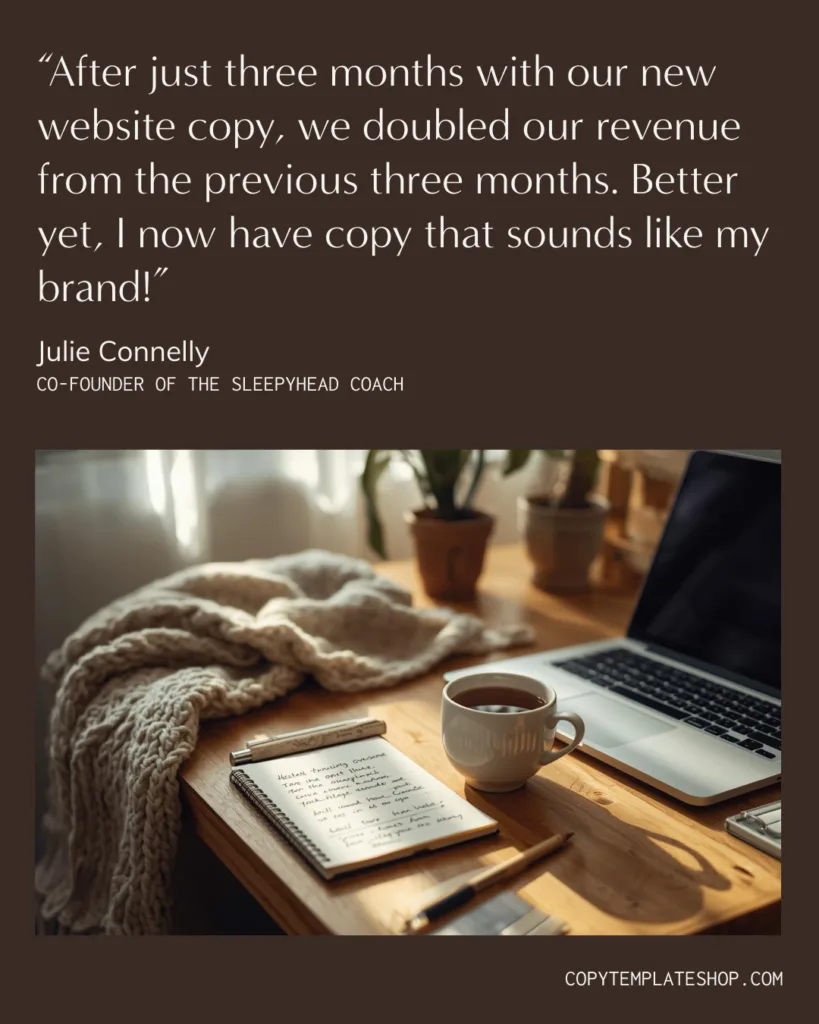
You connect with your audience on a deeper level. One of the most underrated benefits of writing your own copy is that it forces you to do the market research — which means you end up understanding your ideal clients on a more psychological level than if you'd just handed the project off. Conversions start with connection, and connection starts with that deep understanding. Any good copywriter will do this research for you, but when you outsource it entirely, you miss out on developing that understanding yourself.
"Since updating our website copy, now when people visit, they're staying and really exploring and connecting with our content," says Julie Connelly, co-founder of The Sleepyhead Coach and a student of Strongly Brewed Websites. She used the process to understand her ideal client at a level that translated directly into sales — and in three months, with the help of her new website, her revenue had doubled.
You find your voice. Writing your own website copy means doing a real deep dive into your brand messaging — and that work trickles into every other piece of content you create. Your social media captions get sharper, your emails get more readable, your sales calls get easier. It's not just a website project. It's a clarity project.
"I had taken another copywriting course and written copy for my business, but it felt incomplete," says Danae Bloise, a designer for plant-based businesses. "I didn't know what I was missing." After going through Strongly Brewed Websites, she says: "Right away, it started clicking. I was able to write copy that felt authentic for my business. It helped me get to the essence of the most important things I needed to resonate with my target market."
You build real confidence. Writing your own copy forces you to get clear on what makes you different — what you're uniquely able to offer your clients, and why someone should choose you over everyone else. That clarity compounds. When your website is doing the work of qualifying visitors before they ever reach out, the conversations you have are different. The clients you attract are different.
"Working through this really helped me dive deep into what my niche was and get a handle on my messaging," says Michelle Pontvert. "It was helpful beyond just copy. It grounded me where I was with my messaging in general. I've had tons of compliments on my website since then" — and more importantly, she's booking better clients.
A Note from Someone Who Writes Their Own Copy (Yes, Even Me)
I write all of my own website copy. I'm actually in the middle of updating meganelliott.co right now as I shift the direction of my business — and yes, I still find reasons to put it off even though I literally teach this stuff. So if you've been avoiding it too, I get it.
But here's the thing: going through the process of writing your own copy — even once, even imperfectly — gives you something that no amount of outsourcing can. You understand your own business better. You get clearer on your messaging. And you build skills that make every future piece of content easier to write, whether you're doing it yourself or briefing someone else to do it for you.
My Honest Hot Take
Here's the thing I wish more people knew before spending thousands on professional website copy: in most instances, DIYing is not just the cheaper option. It's the better one.
Unless you are fully, completely locked in — solid audience, established offers, zero anticipated changes over the next 6 to 18 months — you're probably not in the right position to get maximum value out of professional copywriting. The investment makes the most sense when you have the clarity to back it up.
And when you DIY it right? You don't just get website copy. You get the skills to update it, improve it, and eventually brief a copywriter properly when the time does come. That's a return that compounds.
If you want support to do it right — not slowly, not from scratch, not while fighting with a blank page — Strongly Brewed Websites is the place to start.
Frequently Asked Questions
Should I write my own website copy or hire a professional?
In most cases — especially if you're still building your business, evolving your offers, or anticipating any changes in the next 12 to 18 months — DIYing is the smarter choice. It's more affordable, gives you skills that compound over time, and means your copy can grow with your business. Hiring a professional makes the most sense when you're fully established, your offers are locked in, and you're ready to invest in long-term messaging strategy.
How much does it cost to hire a website copywriter?
Working with an experienced website copywriter typically starts around $3,000–$5,000 USD and can go significantly higher for full-service packages that include messaging strategy and market research. Budget options exist on platforms like Upwork and Fiverr, but strategic depth and results vary widely. Working with me starts at $5,000.
What if I'm not a good writer?
Being a "good writer" has nothing to do with being a good copywriter. Copywriting is a specific, learnable skill — and with the right structure, templates, and guidance, anyone can write clear, effective website copy for their business. You're not writing a novel. You're communicating what you do and why it matters, and there's a proven process for doing that well.
What's the hardest part of writing your own website copy?
Most people are surprised to find that the hardest part isn't the actual writing — it's making the decisions around structure, calls to action, and what belongs on each page. A good framework takes a lot of those decisions off your plate so you can focus on getting the words right.
How long does it take to write your own website copy?
With proper preparation and a solid framework, most online service providers can write their full website copy in a couple of weeks, dedicating roughly an hour or so a day. Going through a structured course significantly speeds up the process compared to starting from scratch.
Who is DIY website copywriting best suited for?
It's a strong fit for anyone who's newer to business, still evolving their offers, wants to strengthen their copywriting skills, or doesn't want to spend thousands right now. It's also ideal for anyone who plans to eventually hire a copywriter but wants to understand the process first — because the direction you'll be able to give will be so much better for it.
Ready to write website copy that actually sounds like you — and actually works? Strongly Brewed Websites walks you through the whole process, step by step, specifically for online service providers.