Reaching for the same sales page template to sell a $27 download and a $3,000 coaching package? That's the fastest way to end up with copy that connects with no one. The right sales page template depends on what you're selling — which is exactly why we make seven offer-specific ones instead of a single catch-all you have to wrestle into shape.
Those seven — low-ticket, course, membership, done-for-you service, coaching, VIP day, and consultation call — each map to a different offer and a different kind of buyer. Below, you'll work out which one fits your offer, and whether you're ready to grab it and start writing today or you'd rather learn the strategy behind the page first.
Why one generic sales page template won't cut it
Plenty of people try to use one generic sales page template for every kind of offer they sell. It can get you started — but it's nowhere near as strategic as it could be, and it usually shows up right where it counts — your conversion rate, your sales, the DMs stacking up with questions your sales page should've answered.
For one thing, those catch-all templates often weren't created by a copywriter. Sometimes they were! But more often than not, you got them from a business coach, or inside a sales program, or from a designer's freebie. Those people have great intentions and I'm not suggesting anyone's scamming you. They just haven't spent a decade honing copywriting the way I have, so they don't bring the same context to the page.
And the more generic the template, the more generic your sales page ends up sounding. It's missing the nuance you need to actually connect with your ideal buyer and make the sale feel easy. You end up trying to cram your offer into a box it doesn't fit — which is exactly why so many people get frustrated with templates in the first place. They feel like they're being squeezed in a direction that isn't theirs.
Think about your own buying. The decision behind a $27 impulse buy looks nothing like the decision behind a $3,000 investment. A first-time buyer from a cold audience needs different reassurance than a warm lead who's followed you for a year. When you pick a template built for your offer type, you can see how it's structured to support the way that specific offer actually gets bought — and the writing gets so much easier.
Which sales page template is right for your offer?
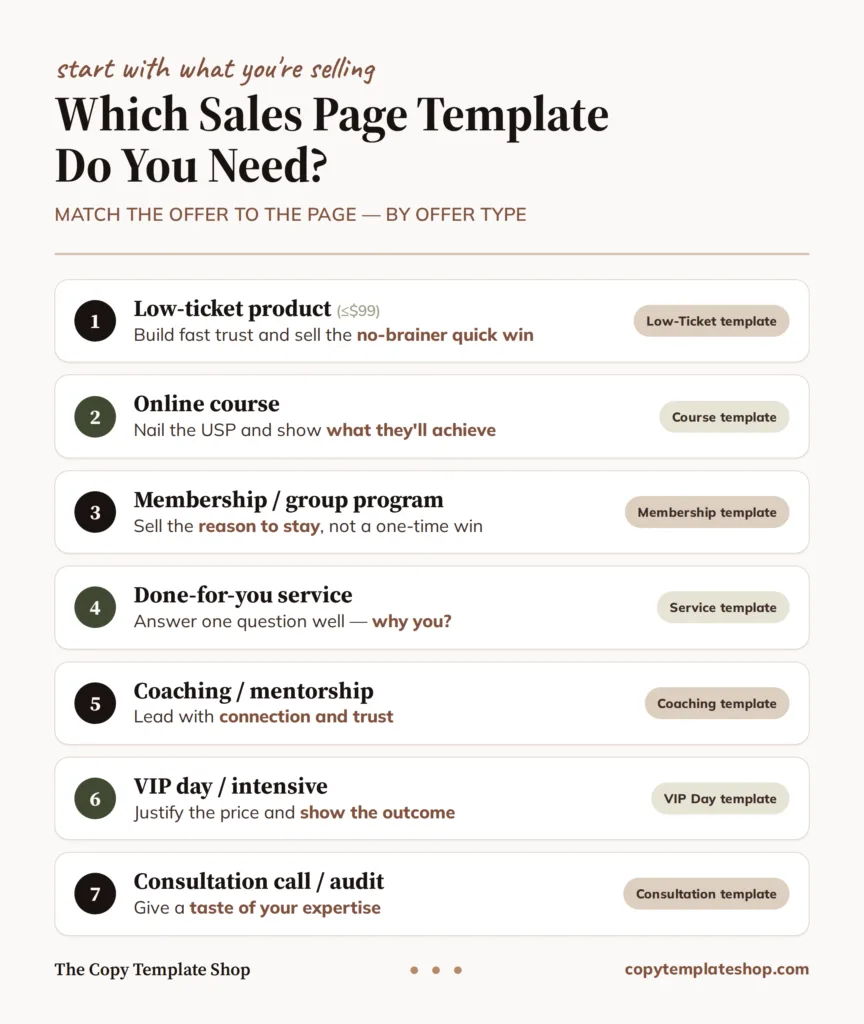
Start with what you're selling, then match it to the template made for that offer's buying journey.
| Your offer | Who's usually buying | What the page has to do | The template |
|---|---|---|---|
| Low-ticket product (≤$99) | First-time buyers, cooler audiences, email-list lingerers | Build quick trust, stack social proof, sell the no-brainer quick win | Low-Ticket Offer template |
| Online course | Warmer buyers weighing a self-guided investment | Nail the USP, show the outcome and the curriculum, ease "will I actually finish it?" | Course template |
| Membership / group program / mastermind | People deciding on ongoing access | Sell recurring value, show what current members are achieving, handle "will I keep using it?" | Membership template |
| Done-for-you service | Prospects comparing you to other providers | Answer "why you?", position your specific flavor, drive the inquiry | Service template |
| Coaching / mentorship | People essentially buying a relationship with you | Lead with connection and trust, show real client outcomes | Coaching template |
| VIP day / intensive | Ready-to-move buyers who want speed | Show the depth of a compressed offer, reduce the risk, spark action | VIP Day template |
| Consultation call / audit | Warm-ish buyers wanting a taste of your expertise | Give a real taste of your expertise, make booking effortless | Consultation template |
A little more on each:
Low-ticket offers (≤$99). These usually go out to first-time buyers and email-list lingerers who haven't spent money with you yet — a cooler audience. The Low-Ticket Offer Sales Page Template leans on social proof, authority-building, and outcome-focused messaging to nudge those first-timers gently toward the sale. (Kelly used it to "write a BOMB sales page within just an hour.")
Online courses. A course page lives and dies on a sharp USP — the line that makes it clear why your course beats the other ways they might solve this, whether that's teaching themselves with AI, piecing it together from free content, or outsourcing it altogether. The Course Sales Page Template helps you land that and spell out what students will actually be able to do by the end, so the investment feels like a no-brainer. If you're stuck on the USP piece specifically, this post on writing a course USP is a good primer.
Memberships, group programs, and masterminds. Recurring offers are a different puzzle — you're not selling a one-time win, you're selling a reason to stay. The Membership Sales Page Template is built to highlight long-term value, show what other members are achieving, and answer the unspoken "will I actually use this?" objection before it kills the sale.
Done-for-you services. Selling a service isn't like selling a course, so it shouldn't use the same page. When someone lands on your services page, they're weighing you against every other provider who does more or less what you do. So the whole job of the page is to answer one question really well — why you? Not why hire a designer (or copywriter, or VA) in general, but why hire you. That means making the distinct flavor of working with you impossible to miss — your specific approach, your point of view, the way you actually get people results. That's what makes the right clients think oh, this is the one and reach out instead of scrolling past. The Service Sales Page Template is built to draw exactly that out. (Megan R wrote, designed, and published her service page "in a day.")
Coaching and mentorship. People buying coaching are, more than anything, buying a relationship with you. So a coaching page leads with connection and trust, then backs it with client outcomes. The Coaching / Mentorship Sales Page Template is plug-and-play for exactly that. Micaela used it for a new group coaching program and said it made the whole offer "feel so much more possible."
VIP days and intensives. A VIP day or intensive has a tricky selling job — justifying a higher price for what looks, on the surface, like just a day of your time. The VIP Day Sales Page Template helps you lay out exactly what gets done inside that window, the result the client walks away with, and why that focused time is worth it — so the page settles the "is a day really enough?" doubt before it costs you the sale. Zoe opened it and, two hours later, had a "completely restructured and refreshed" day-rate page.
Consultation calls and audits. For a paid call, audit, or Day-of-Voxer offer, the page has to give a taste of your expertise in every line so booking feels like a smart, low-risk yes. That's what the Consultation Call Sales Page Template is for.
Not sure which one fits your offer? You can browse all the sales page templates side by side to compare — or head to our contact page, tell us what you're selling, and we'll point you to the right one.
Prefer to learn the strategy before you write? Meet Sales Page Slumber Party
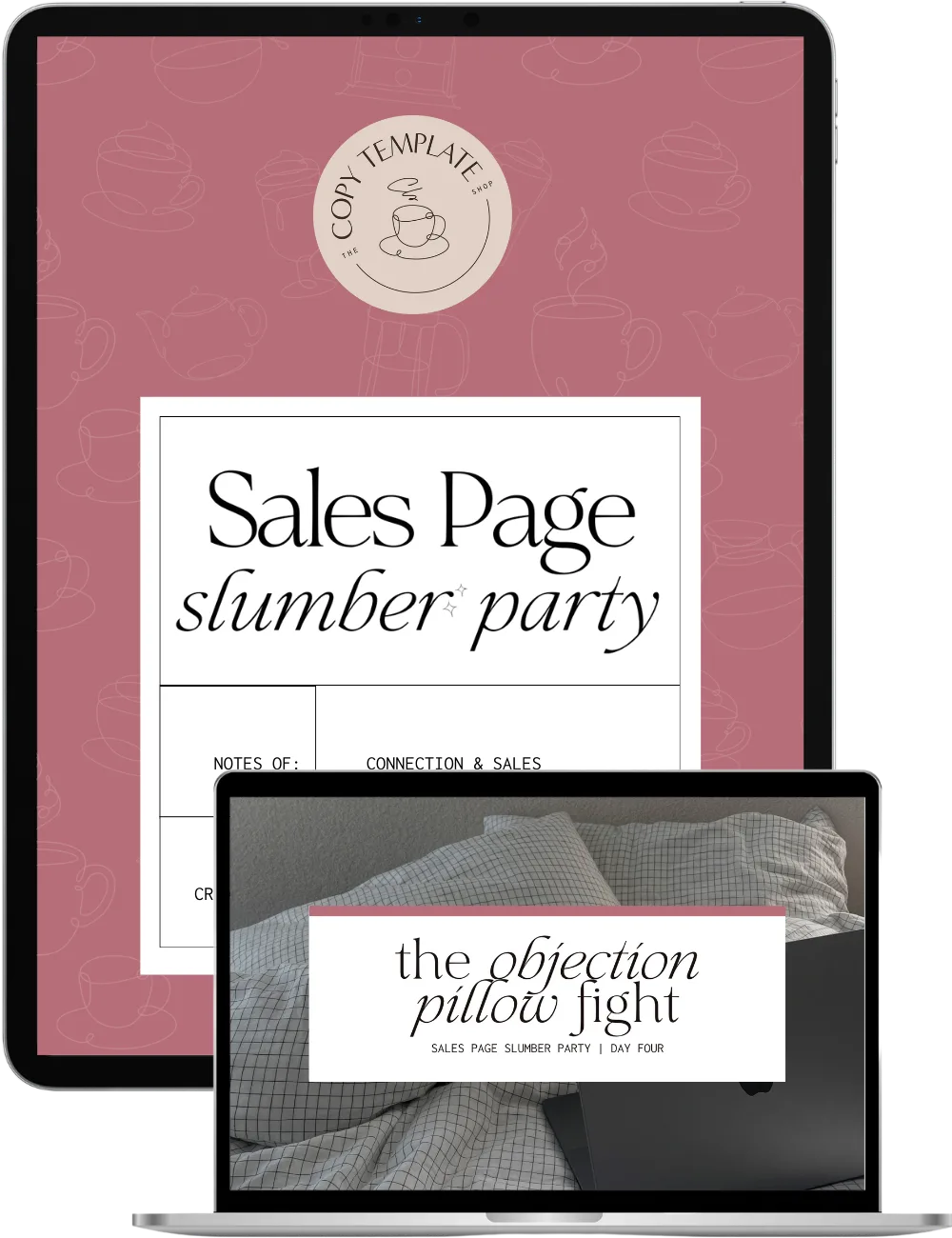
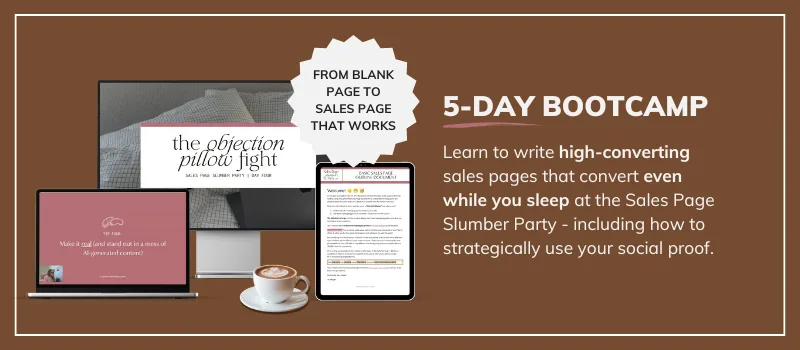
Everything above assumes you already understand the strategy behind a sales page. A template hands you a proven, offer-specific structure — but it can't teach you why each piece works. If you're not there yet, that's exactly what Sales Page Slumber Party is for — a five-day, on-demand bootcamp that walks you through the messaging and sales-psychology fundamentals behind a high-converting page, so you understand how sales pages actually work before you sit down to write one.
One thing worth clearing up — the Slumber Party comes with a generic sales page outline to write from, but it's designed to be used alongside an offer-specific template, not instead of one. It teaches you the strategy step by step; the offer-specific template handles the nuance for your particular offer type. Plenty of people go through the bootcamp to learn the thinking, then reach for the matching template so the writing goes faster and lands sharper. The two are built to work together.
So which do you need? It comes down to your confidence level.
If you already have a really good grasp on your offer's messaging, and you understand the basic sales psychology behind a high-converting page, skip straight to the template. You know your USP, you've thought through the objections specific to this offer — grab the right one and go.
But if you're not 100% confident about what actually needs to go on your page — you haven't mapped out your offer's specific objections, your unique selling proposition, or exactly who you're talking to — that's where the Slumber Party earns its keep. It walks you through those fundamentals step by step, so you understand the why before you write a single line.
And honestly, everybody benefits from understanding the psychology of a sales page — it's the difference between copy that's fine and copy that's really, really good. Because the Slumber Party is such a low-ticket investment, you go through it once and come back to it again and again — every future offer, every future launch. That first time through, you'll learn a ton, and not just about copywriting. About selling, full stop. (Ashley, one of the students, wrote a sales page for the very first time instead of just posting in her Facebook group — and had her first sold-out launch.)
Quick gut check:
- Grab the template if you know your offer's messaging and just want a proven, offer-specific starting point so you can write faster.
- Start with Sales Page Slumber Party if you want to understand the strategy behind the page and build copywriting skills you'll use for the life of your business — then grab the matching template when you're ready to write.
Can you just use AI to write your sales page?
Fair question. And the honest answer isn't a flat no.
AI is genuinely great for brainstorming a sales page. What it's not great at is understanding nuance. When you ask AI to write a sales page for your offer, it doesn't weigh the things a professional copywriter would. It doesn't consider your price point and how that dictates the way the page is structured. It doesn't consider how your offer is delivered — how much one-on-one access to you is baked in versus how much is self-study — which also changes the structure. It doesn't factor in how cold or how warm your audience is.
Can you prompt your way to a better result? Sometimes — but only if you know exactly what guidance to give it. And if you're not a copywriter, chances are you don't know which pieces of information actually dictate how a sales page should be built and what it needs to say. That's the real gap.
A copywriting template takes that guesswork off your plate. It was prepared by a professional copywriter who understands the nuance — and who knows there's context she can't see, because she hasn't laid eyes on your specific offer. So the template walks you through those decisions, right there in the doc, so you can make them yourself. That's the whole point — a template keeps you in the driver's seat as the strategic decision-maker, instead of handing the wheel to a tool that doesn't know your business.
And you can absolutely still use AI alongside it. If you hit a section and none of the fill-in-the-blank options are landing for you, no problem — you'll know exactly how that section works, why it belongs, and what kind of messaging needs to go in it. From there, you can use AI to help brainstorm the actual words. You're just doing it with a copywriter's judgment instead of hoping the robot guesses right.
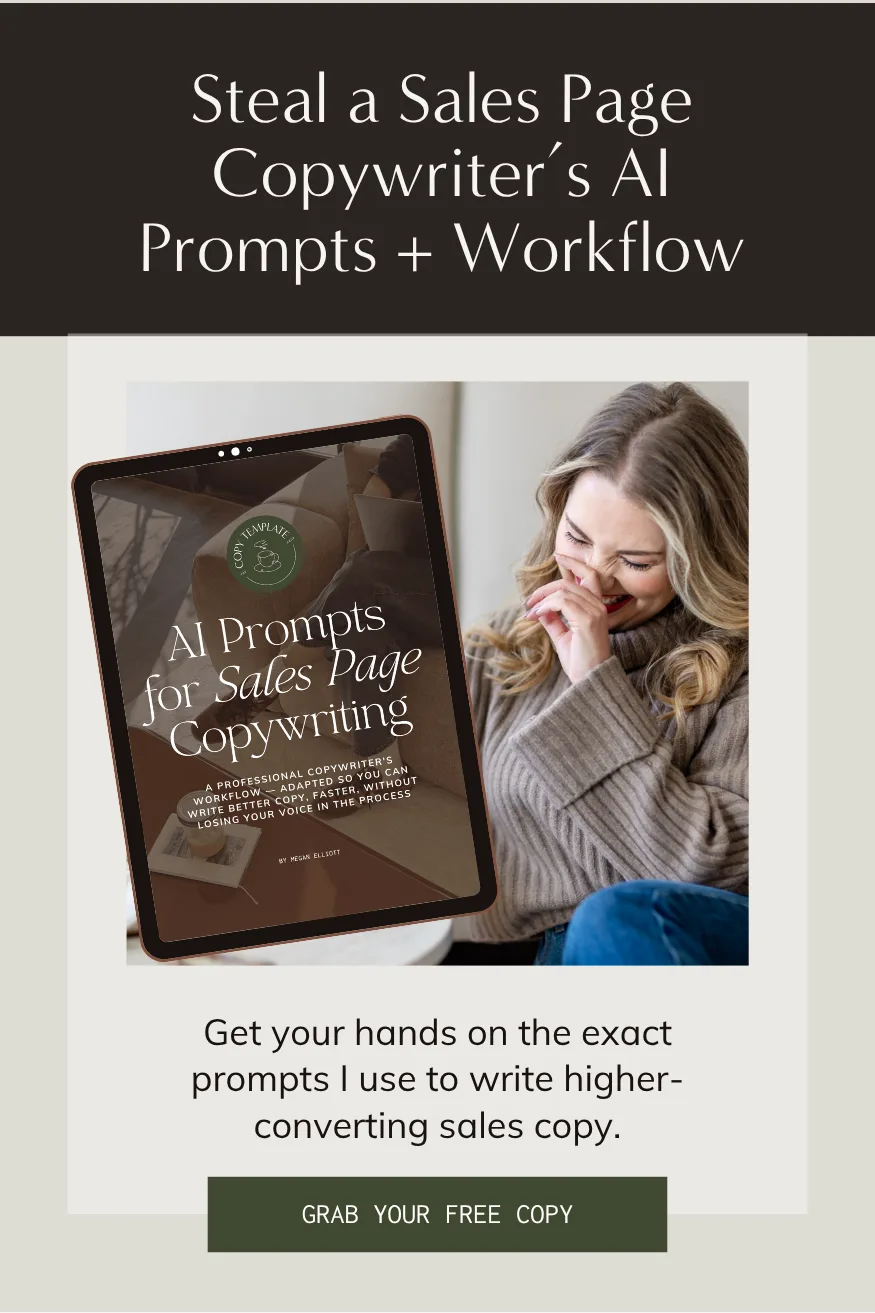
Want a head start? Grab the free AI Prompts for Sales Pages — the exact prompts I'd use to brainstorm and pressure-test your messaging before you write.
What a sales page template will (and won't) do for you
Buying a template isn't like waving a wand and having a finished sales page appear. But it will take you so much less time. On average, people who buy our sales page templates write their page in one to two hours — instead of the full day, several days, or sometimes several weeks it takes from a blank screen. And you'll feel far more confident in the result than if you'd just asked ChatGPT or Claude to spit one out.
There's that saying — you have to understand the rules so you can break them. That's exactly how these templates are built. They teach you the best practices, so once you understand why each section works, you can go in and break the rules on purpose: play around, make changes, do it your way. You won't come out a copywriter, and you don't need to. You'll come out understanding copywriting well enough to make it yours — with something you feel genuinely good about, because it's grounded in best practices you actually understand.
It's also the answer to the question I hear most — will this still sound like me? It will, because the template is built to draw your voice out, not replace it. You get multiple prompts and sentence options for every section — two people in the same industry end up with completely different pages, because the template makes you show up in your own messaging.
"This template (like all the Copy Template Shop templates) hit the balance between helping me be super strategic and giving me something to start from — but I still feel like my copy sounds like ME." — Micaela
"This template made it soooo easy to create my sales page! Copywriting takes me forever, and I'm not very good at it. Having a step-by-step framework I could follow… I finished the entire thing — wrote, designed, and published a sales page for my new offer — in a day. And I feel confident about the end result!" — Megan R.
Frequently asked questions
Do I need a different sales page template for each offer?
Yes. Someone buys a $27 product very differently than a $3,000 service, so one template can't sell both well — and that mismatch is the most common mistake I see. Offer-specific templates are built around the buying psychology of each type: a low-ticket page leans on quick wins and proof, while a coaching page leads with connection. Match the template to the offer and both the writing and the conversions get easier.
Will a sales page template make my copy sound generic?
No, as long as it's a good one. Generic, one-size-fits-all templates do tend to produce generic pages. But offer-specific templates built by a copywriter give you multiple prompts and full-sentence options for every section, so you're making real choices — not filling in a shell. The template draws your voice out; it doesn't paste over it.
Can I write a sales page without being a copywriter?
Absolutely. Each template gives you a proven, offer-specific structure plus prompts and guidance, so you're filling in conversion-focused copy instead of writing from a blank page. You bring the details about your offer; the template handles the persuasion strategy. Plenty of people write their first sales page this way — often in an hour or two.
Should I buy a template or join Sales Page Slumber Party?
Depends on your confidence. If you already understand your offer's messaging and basic sales psychology, grab the template and go. If you want to understand the why behind a high-converting page first, start with Sales Page Slumber Party — it teaches the strategy step by step and comes with a generic outline, but it's built to be paired with the offer-specific template that matches what you're selling, not to replace it.
Can I just use AI to write my sales page instead?
AI is great for brainstorming, but it doesn't account for the nuance that actually determines how a page should be built — your price point, how the offer's delivered, how warm your audience is. A template built by a copywriter bakes that judgment in and keeps you as the strategic decision-maker. Use AI to help draft within the structure once you understand it — not to make the strategic calls for you.
Ready to write a sales page that actually sounds like you?
Pick the path that fits where you are. If you know your offer's messaging, browse the offer-specific sales page templates and write your page this week. If you want to understand the strategy first, start with Sales Page Slumber Party and build skills you'll use for every offer you ever launch. And if you just want to warm up, grab the free AI Prompts for Sales Pages to brainstorm your messaging before you write.
Still figuring out the basics? Start with what a sales page actually is, then dig into sales page structure and how to write one that converts. Or, if you'd rather hand the whole thing off, you can always work with me directly.