You've been meaning to write your about page for months.
Maybe you have a draft sitting somewhere that you started and never finished. Maybe what's live right now is a bio you threw together when you first launched — one that still has a typo in it — and you've been quietly embarrassed about it ever since. Or maybe the page just doesn't exist yet, and every time you think about writing it, you open a blank document, stare at it for ten minutes, and close it again.
If any of that sounds familiar, you're in the right place.
Your about page is one of the most important pages on your website — and one of the most misunderstood. Most people treat it like a formality. A quick introduction. A résumé with a headshot. But a well-written about page is doing something much bigger than that.
It's answering the question every visitor is asking the moment they click on it: Why should I trust this person with my problem?
Learning how to write an about page that actually answers that question — and keeps people reading long enough to find out — is exactly what we're covering here.
Why Your About Page Matters More Than You Think
If you were to pull up Google Analytics right now, I would almost guarantee that your About page is your second or third most visited page on your entire site. Think about your own browsing behavior when you're considering working with or buying from someone new: you almost always click "About" before you make any kind of commitment.
That's because your about page is where the trust decision gets made.
By the time a visitor lands there, they're already interested. They found you, they liked what they saw on your homepage or services page, and now they need to answer one more question before they move forward: Is this someone I can trust with my problem?
Your about page isn't just background information. It's sales copy. It's the page that builds the know, like, and trust factor that moves someone from "interesting" to "I need to work with this person." Every single time someone new lands on your site, your about page is working — or it isn't.
The Mistake Most About Pages Make
The biggest mistake isn't saying the wrong thing. It's leading with the wrong person.
Most about pages open with the business owner's name, their credentials, maybe a paragraph about where they studied or how long they've been in the industry. And none of that is inherently wrong — it's just that if it's the first thing your reader encounters, you've already lost them.
Most people do it backwards. They lead with themselves when the reader is sitting there wondering: does this person even understand what I'm dealing with?
Your about page should make your reader feel seen before they know your name. Before you introduce yourself, show them that you understand who they are and what brought them to your site. Speak to their problem, their frustrations, the outcome they're working toward. That's what pulls them in — not your resume, not your story, but the moment they read something on your page and think: this person really gets me.
Once you've built that connection, you've earned the right to tell your story.
How to Write an About Page: Section by Section
A high-converting about page isn't a random collection of information about you. It follows a clear structure, where every section has a specific job to do in moving your reader from "who is this?" to "I need to work with them."
Each section, and what it's doing for you:
The Attention-Grabber
Your opening doesn't start with your name. It starts with your reader. A strong attention-grabber leads with the outcome they're after, or the problem they're ready to solve. Its job is simple: make them feel, within the first few seconds, that they're in exactly the right place.
The Connector
Before you introduce yourself, show your reader that you truly, deeply understand them. Not in a vague "I totally get it!" way — in a "you just described exactly what I'm going through" way. This is where voice-of-customer language does the heavy lifting. Speak to their specific frustrations, desires, and experiences. This is the section that creates the kind of immediate connection that keeps people reading.
The Introduction
Now — and only now — you bring in yourself. Keep it brief: 2–3 sentences that function like an elevator pitch. Who you are, who you help, and what you help them do. This isn't your full story. Save that for what comes next.
Your Story
This is the heart of your about page, and it's also the section most people either skip entirely or fumble the most. Your story isn't your life history. It's the narrative arc of your business journey — a beginning (where you started, what you struggled with), a turning point (what shifted or what you discovered), and where you are now (what that whole journey made you uniquely positioned to do for your reader).
A well-told story does two things at once: it builds authority and drives connection. When your reader sees themselves in where you started, they believe you understand their experience. When they see where you've arrived, they believe you can help them get there too. This is the reason people hire someone not just because they're qualified — but because they feel like they actually know them.
Credibility Signals
This is where you bring in third-party proof: media features, recognizable client logos, credentials that are actually relevant to what your ideal client cares about. The goal isn't to impress them with a wall of badges. It's to give them external validation that you're the real deal — from sources outside of your own website.
Your Values and Differentiators
What makes you different from every other person who does what you do? Not "I'm passionate and I really care" — but specifically. What do you believe about your work that others in your space don't? How does that show up in the experience of working with or learning from you? This section is what makes the right people feel like they've finally found their person.
Your Promise and Call to Action
Close with a clear statement of what you're ultimately working toward for the people you help, and a direct invitation to take the next step. Don't leave your reader guessing what to do after they finish your about page. Tell them exactly where to go.
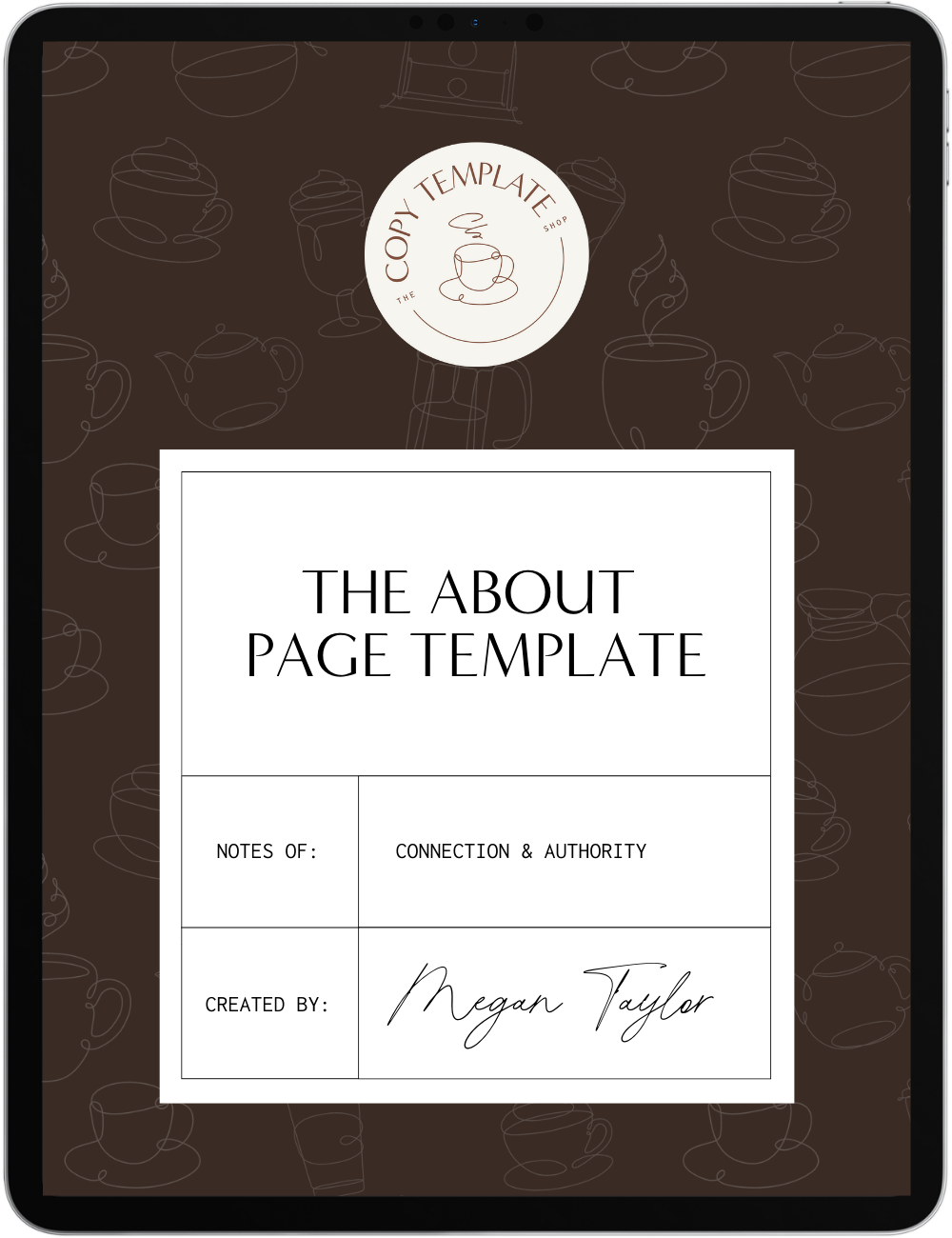
If you want a full breakdown of how to structure each of these sections on the actual page — including guidance on layout and formatting — the About Page Copy Template includes a layout outline document that maps it all out for you.
What to Do If You're Stuck
If you're staring at a blank page and getting nowhere, here's the reframe that tends to help the most.
Your about page is just a conversation.
When someone clicks on your About page, they're walking up to you and asking: "Who are you? What's your story? Why should I trust you?" If someone said that to your face, you'd answer them. You'd talk about your work, why you care about it, what makes you someone worth listening to.
Your about page is that exact same conversation — just in writing.
And if you're convinced you're not interesting enough to pull it off, I want to push back on that entirely: your about page doesn't have to make you sound like the most fascinating person on the internet. It just has to make your reader feel like you get them, and like you're someone they'd trust with their problem.
You don't have to be interesting. You just have to be trustworthy.
Take web design mentor Danbee Shin. Her about page goes deep into her web design journey — the beginning, the turning point, where she landed — because that story is central to her business. Her potential mentee clients want to know she's been exactly where they are. They want to understand her struggles, her path, her perspective. They hire her because they see themselves in her story, and they trust that she can help them get where they want to go. The relatability is the selling point.
If you care about the people you help and you believe in the work you do — you have everything you need to write a great about page. The hard part isn't finding the story. It's knowing how to structure it so it actually lands.
The About Page Copy Template walks you through each section with fill-in-the-blank copy formulas, so you can plug in your story, your details, and your voice — and end up with an about page that actually sounds like you and actually does its job.
(And if you'd rather hire a copywriter to write your about page for you, that's always an option, too.)
Frequently Asked Questions
How long should an about page be?
Long enough to cover each section of the framework — short enough that every word is earning its place. A well-structured about page is typically longer than most people expect, because you're building real connection, not writing a Twitter bio. Focus on substance, but cut anything that isn't moving your reader closer to trusting you.
Should my about page be about me or my customers?
Your customers first, then you. The page is technically about you — but it should open by speaking to your reader, not yourself. Show them you understand who they are and what they're looking for before you start talking about your own story and background. The about pages that actually convert are the ones where the reader thinks "this person gets me" before they've even learned your name.
What should I not put on my about page?
Credentials that aren't relevant to what your ideal client actually cares about, a third-person bio, a wall of text with no personality, and anything that sounds like it was lifted from a LinkedIn profile. The biggest omission I see, though? The story. A formal bio without a narrative arc completely misses what the page is actually for.
Do I write my about page in first or third person?
First person, almost always. Writing in third person ("Jane is a designer who...") creates instant distance and sounds like a press release. Your about page should feel like a direct conversation — and third person kills that entirely.
How do I write an about page if I don't feel interesting enough?
You don't need to be interesting. You need to be trustworthy. If you understand your reader's problem, have experience working through it, and can show that you genuinely care about helping them — you have everything you need. The structure does the rest.
Ready to Finally Write Your About Page?
If you've been putting it off because you don't know where to start, the About Page Copy Template gives you the exact section-by-section framework to get it done. Fill-in-the-blank copy formulas, a layout guide for the actual page, and enough options that your page sounds like you — not like a template.
Grab the About Page Copy Template →
And if your about page isn't the only thing that needs work — if you're looking at your whole website and thinking none of this sounds right — Strongly Brewed Websites is the full website copywriting course that walks you through writing every page, from your homepage to your services page to your about page, so your site finally says what you actually mean.