It’s 3am. My baby won’t sleep and I’m pretty sure he’s teething. So I do what any exhausted parent does — I open Google, read the AI-generated clip at the top, and close my phone. I don’t scroll. I don’t click through to five different articles.
A lot of service providers have watched this shift happen and quietly crossed SEO off their list. Big mistake — especially if you’re an online service provider.
Because the 3am teething search is an informational search. Your ideal client searching “copywriter for wellness brands” or “virtual assistant for coaches”? That’s a search with purchase intent. And those are a completely different animal.
Key takeaway: SEO for online service providers isn’t dead — it’s changed. The shift to AI-generated results affects informational searches most. Searches with purchase intent still send people to actual websites. You need to be there when they look.

Does SEO still work for service based businesses in 2026?
Yes — and the AI overview shift actually makes showing up more important, not less.
When someone searches Google with purchase intent — “I need a copywriter,” “hire a virtual assistant for my business,” “web designer for my health brand” — an AI summary doesn’t satisfy them. They’re clicking through. They want to see who you are, what you do, and whether you’re the right fit for them specifically. That requires your actual website.
Think about the last time you hired someone for your own business. Maybe you needed a virtual assistant to help exclusively with inbox management. You probably asked for referrals — but you also probably opened Google and searched “virtual assistant inbox management.” Your ideal clients are doing exactly the same thing when they’re looking for someone like you.
Now imagine you got referred to someone, and that person also showed up on the first page of Google when your ideal client searched. That’s a double whammy. You become almost impossible to overlook.
The biggest mistake I see service providers making in 2026 isn’t doing SEO wrong. It’s not doing it at all because the landscape feels too overwhelming. The fundamentals are still solid, and the barrier to entry is genuinely lower than you think.
Do you need a blog to rank on Google?
No — and my own business is a case in point.
For years, my service-based business website had no blog. None. And I was ranking in the first one to three spots on Google for “copywriter for women entrepreneurs” — a keyword that brought me inquiries from complete strangers saying, “I found you on Google.” No content strategy. No weekly publishing schedule. Just intentional copy on my core website pages.
I’m not going to tell you that having a blog hurts you — it doesn’t. The more quality content you create, the more Google sees your site as an authority, and the better your SEO will perform over time. But if you’re waiting until you have a full content strategy before you start thinking about SEO, you’re leaving clients on the table.
What you actually need to get started:
- A homepage with clear, keyword-informed copy that speaks directly to your ideal client (here’s how to write homepage copy that converts)
- An about page that positions you for the right audience (how to write an about page that actually converts)
- Individual service or offer pages for each thing you sell — not a single generic “services” page (more on building a services page that works)
- A contact page
Each of these pages is an opportunity to be found. The key is being intentional about the copy you put on them — not just “here’s what I do” copy, but copy that answers what your ideal client is actually searching for.
Not sure your current website copy is doing that job? The free Website Copy Roadmap is a great place to start.
How to do keyword research as a service provider (the 2026 approach)
Keyword research has a reputation for being complicated. It’s not.
The goal is simple: figure out what your ideal client is typing into Google when they’re ready to hire someone like you. Not what you wish they were searching. What they’re actually searching.
This is why specificity is everything. You’re never going to rank for “copywriter.” The competition is enormous and the intent is all over the place. But “copywriter for female entrepreneurs”? “Web designer for health brands”? “Virtual assistant for solopreneur moms”? Those are winnable — and more importantly, they attract exactly the right people.
Start with your niche. Get really clear on who you serve. Not just “coaches” — what kind of coach? Not just “small businesses” — what industry, what stage, what specific niche? Then think about how they would describe themselves. What words would they use when they’re searching for someone like you? That’s the keyword research.
On search volume in 2026: The old rule of “only target keywords with 100+ monthly searches” doesn’t hold up anymore. SEO experts increasingly point to zero- and low-volume keywords as some of the highest-converting targets, precisely because the specificity that lowers the search volume is what raises the intent. Someone searching “copywriter for wellness coaches” is a far better lead than someone searching “freelance copywriter.”
For most online service providers, one or two new client inquiries a month is meaningful growth. One or two people finding you through a very specific keyword and reaching out is plenty. Stop optimizing for volume. Start optimizing for the right person.
You can use free tools like Google’s autocomplete and the “People Also Ask” boxes to see how your ideal clients are phrasing their searches — no paid subscription required. Google Search Console (more on that below) will also show you exactly what queries are already bringing people to your site.

How to optimize your website copy for SEO
Once you have your keyword, the job is putting it in the right places — not stuffing it everywhere, but being deliberate.
Where your keyword should appear on each page:
- The page title (H1)
- Your first paragraph — ideally within the first two or three sentences
- At least one subheading (H2 or H3)
- Your meta title and meta description (the text that appears in Google search results)
- The URL slug (e.g.,
/copywriter-for-female-entrepreneurs) - Naturally throughout the page, wherever it reads well
One page, one primary keyword. Each core page on your site should target its own specific keyword. Your homepage might target “copywriter for course creators.” Your VIP day page might target “VIP day copywriter.” Your about page might target “copywriter for female entrepreneurs.” This isn’t duplication — it’s building multiple entry points to your site.
A question that comes up constantly, especially from people who go through Clients from SEO: “But I do multiple things. I have different offers, different packages, different audiences. How am I supposed to get found for all of it?” The answer is that you can add more pages. This isn’t about becoming a blogger or adding a ton of content. If your offers are genuinely different enough that people would search for them differently, you need different pages for them — a separate sales page for each service, maybe separate landing pages for different audiences. Your website structure and your SEO strategy are the same conversation. Wondering whether you should write your own website copy? That post covers when DIY makes sense and how to approach it.
E-E-A-T is actually great news for service providers. Google’s E-E-A-T framework — Experience, Expertise, Authoritativeness, and Trustworthiness — is a significant ranking signal in 2026, and honestly? We are primed for it. As service providers, we already know that the way we get clients is by showing up with our experience and expertise. The same things that make a client hire you are the things that make Google trust your site.
You probably have great testimonials and case studies just sitting there. Make sure they’re actually appearing on your pages — not hidden on a separate “testimonials” page that no one visits. That content feeds directly into Google’s E-E-A-T signals. Same for trustworthiness: the positioning and messaging work you’ve done, your story, the reasons a client should trust you — those belong on your about page and in the bio sections of your sales pages. Just show up honestly, dial in your messaging, and make sure your expertise is actually visible on the page. You’re automatically going to make Google like you.
Start here: set up Google Search Console
If you’ve read this far and you’re feeling a little overwhelmed — this is where I want you to start. This is the one action you can take today.
Go set up Google Search Console on your website. It’s completely free. And if you think you might already have it — go check. Double check. Triple check. I’ve talked to people who were convinced they had Search Console set up, but it turned out they’d only connected Google Analytics. Those are two different tools and they tell you two different things. Analytics tells you about behavior on your site. Search Console tells you what Google thinks of your site — and that’s the data you actually need.
Once it’s running, you’ll see which searches are surfacing your site, where you’re ranking, how many people are clicking through, and where the gaps are. That’s what turns SEO from a guessing game into something you can actually act on.
Here’s how to read what it’s telling you:
- Near-zero impressions: Your pages aren’t optimized for any keyword yet. That’s where to start.
- High impressions, low clicks: Your ranking is decent, but your meta title or meta description isn’t compelling enough to earn the click. Rewrite them.
- Ranking on page two or three: A targeted copy update is often enough to push a page onto page one. Add the keyword in more strategic places and re-submit.
- Ranking in positions 8–15 on page one: You’re close. A stronger meta description alone can meaningfully improve your click-through rate.
Once you make any updates to a page, request re-indexing in Search Console. You no longer have to wait months for Google to catch up. I’ve seen meaningful movement in two to four weeks — sometimes faster. The “SEO takes forever” narrative is outdated.

Why I created Clients from SEO
I want to be upfront about something: I am not an SEO expert. I’m an SEO-informed copywriter. And the strategy inside Clients from SEO is not some sophisticated system I studied for years.
It’s what I actually did, in the laziest possible way, on my own service business website.
I didn’t have a blog. I wasn’t obsessing over my rankings or constantly updating my copy. I just used my knowledge of copy and keywords to be intentional about the words on my core pages, and I left it alone. For years after that, I was getting inquiries from complete strangers — people who would say, “I found you on Google.” I was ranking in positions one to three for “copywriter for women entrepreneurs” — exactly who I was trying to reach.
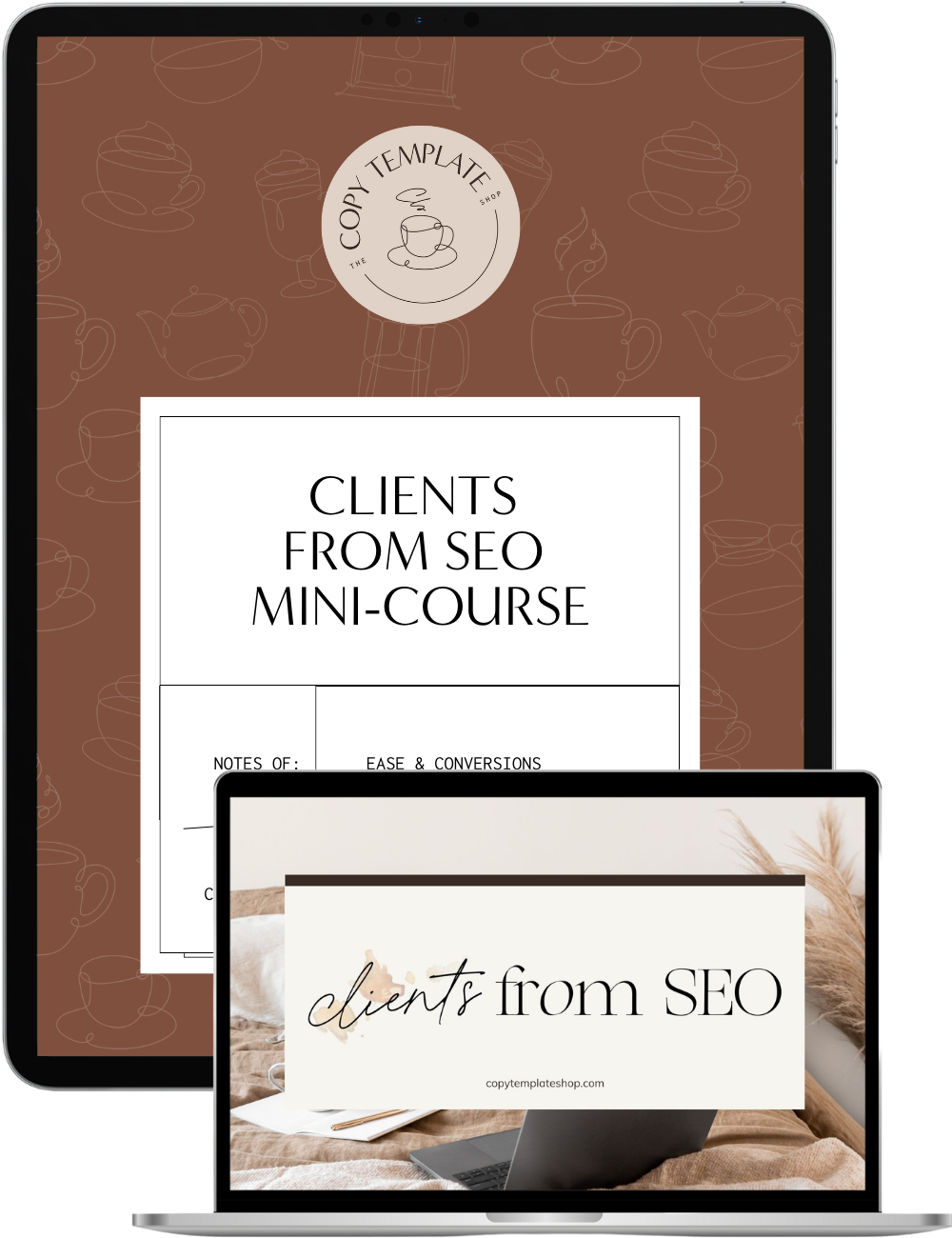
Eventually I reverse-engineered what I’d done and turned it into a course. That’s Clients from SEO. It walks you through the exact same strategy: finding the right keywords for your niche, optimizing your core website pages, and using Google Search Console to track what’s working. No massive content strategy. No SEO expertise required.
Results people are getting
Zoe sent a message after implementing the keyword tips from Clients from SEO on her services page and her one blog post. The keywords she targeted weren’t super popular — but her rankings went up significantly. As she put it: “tiny tweaks make a big difference.”
Kat had been searching for SEO training that was easy and actually to the point for a while. When she saw the strategy for getting new clients without being constantly present on social media, she said it was the answer to her prayers.
Rachael, a photographer based in Paris, came in having never thought about her website this way. She left the workshop having realized things she’d never considered — including that she had a whole section of proposals on her site, but nothing specifically for engagements. Entire keywords she hadn’t even thought to target, just waiting there.
Frequently Asked Questions About SEO for Service Based Businesses
Does SEO work for service based businesses?
Yes — and it’s particularly powerful for online service providers whose ideal clients are actively searching for help. When someone searches “copywriter for wellness brands” or “virtual assistant for coaches,” they’re in hiring mode. Showing up in those results puts you in front of people who are already ready to invest, without relying entirely on referrals or social media.
Can I get clients from SEO without having a blog?
Absolutely. A well-optimized homepage, about page, and individual service or offer pages can rank on Google without a single blog post. The key is intentional copy — using the keywords your ideal clients are actually searching, placed in the right spots on each page. A blog strengthens your SEO over time, but it’s not required to start getting found.
What keywords should I target as an online service provider?
Focus on long-tail keywords that combine your service type with your niche or ideal client. Think “copywriter for female entrepreneurs,” “web designer for health brands,” or “virtual assistant for solopreneur moms.” The more specific you get, the less competition you face — and the more likely you are to attract someone who’s exactly the right fit.
Does keyword search volume still matter in 2026?
Less than it used to. SEO experts consistently point to zero- and low-volume keywords as high-converting targets, because the specificity that lowers the volume is what raises the intent. One person searching your very specific keyword and hiring you is worth far more than 500 people bouncing off a page that wasn’t really for them.
How long does SEO take to work for a service business?
Much faster than the old “it takes six months” narrative suggests — especially if you’re re-indexing your pages in Google Search Console after every update. Meaningful movement in two to four weeks is realistic. What matters more than time is whether your pages are actually optimized and whether you’re actively telling Google to take a fresh look.
What’s the difference between local SEO and SEO for online service providers?
Local SEO focuses on location-based searches — “plumber near me” or “coffee shop in Austin.” If you work with clients anywhere via Zoom, email, or online platforms, that’s not what you need. Your focus should be on targeting the type of client you serve rather than a geographic area. Niche-specific, long-tail keywords are your leverage point.
If you’ve been putting off SEO because it feels like the rules have changed too much to bother with — I get it. But the fundamentals are still solid, the tools are still free, and your ideal clients are still searching. Clients from SEO is where to go when you’re ready to stop guessing and start getting found.