
The Copy Template Shop
Copywriting templates for online entrepreneurs
Launch Copywriting:
The Only Checklist You’ll Ever Need
By Megan Elliott, founder of The Copy Template Shop
12-MINUTE READ · USED BY 200+ ONLINE ENTREPRENEURS
This guide contains affiliate links
Launching a new offer, or relaunching one of your best sellers, and want to make sure that you’re not missing any aspect of your launch copywriting? You’re in the right place!
There are tons of moving pieces in a launch — sales pages, emails, social media posts, and more — and having some sort of launch copywriting checklist can really help you demystify the whole process. Especially when you consider that no two launches ever look the same!
The type of copy you’ll need for your launch depends on several factors: whether you’ve launched before, your launch strategy, what resources you have available, and so on. This post will be a comprehensive guide to launch copy to help you nail your next launch.
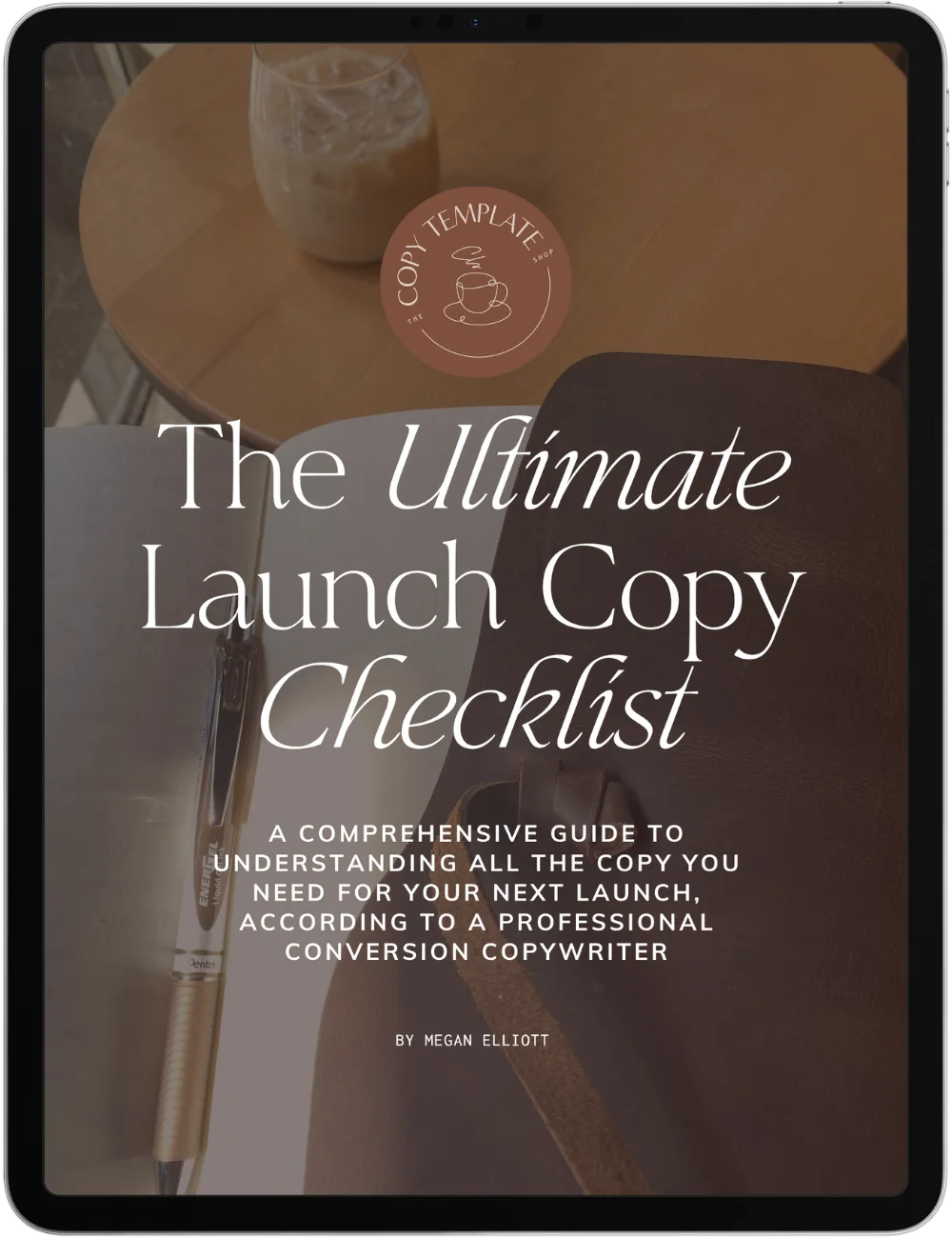
Want a personalized launch copywriting checklist?
Our free tool generates a custom checklist based on your offer, launch style, and timeline.
Join 200+ entrepreneurs who’ve used the personalized checklist to plan their launches
Pop up not working? Try this form instead.
Contents
There are a lot of moving pieces that fit into a launch (“Tell me something I don’t know”, right?), so this resource is a bit on the longer side. Here’s exactly what we’re going to cover:
Weigh your launch options
Other launch timeline considerations
Write your sales page copy
Write your checkout page copy
Write your order bump copy
Write your upsell copy
Write your thank you page copy
Your Pre-Launch Promo Plan
Your Launch Promo Plan
Sales Email Copy
Facebook Ad Copy
Affiliate Swipes
Legal copy
Downsell copy
Post-purchase delivery email copy
Website promo copy
Customer service scripts
Step One: Figure out your launch timeline
There are a ton of different ways that you can approach your launch and even more possible strategies that you can follow. But the approach you choose is really going to come down to one key question: how much time, energy, and resources do you have available?
Weigh your launch options
There are 3 different variations of each launch:
- The “regular” launch — This is your ideal launch; a sort of “Goldilocks” sweet spot between just getting your offer out there versus going above and beyond.
- The minimum viable launch — This involves all of the tasks that absolutely must happen for your offer to launch. No bells and whistles, no frills; just the bare minimum tasks that can’t be missed.
- The extra mile launch — This is the perfect-world version of your launch, where everything runs smoothly and you get to add all the bells and whistles you could possibly dream up.
In the initial planning stages, do a brain dump of all of the things you’d like to do in your launch. Then, see where each of these tasks fits in the above model. Is each task an “extra mile” task, a “minimum viable” task, or somewhere in between?
By doing this, you’ve gotten really clear on what absolutely needs to be done versus what your dream launch would look like. Your actual launch will likely fall somewhere in the middle of those two options.

Other launch timeline considerations
Knowing your different options is really helpful once you start to consider how much run-up time you actually have to play with. If you’re hoping to launch in 2 weeks, you’re probably going to want to stick with your minimum viable launch. But if you’ve got 2+ months to work with, you can start looking at tasks in your “extra mile” launch plan.
Ask yourself these questions to come up with a clear launch timeline:
- How much warm-up time do you have before your pre-launch event or cart open?
- Will you be using a waitlist strategy?
- Are you planning a pre-launch event? If so, is it a single-day or multi-day event? (More on this later)
- How many days will your cart be open?
- How much support do you have? Can you outsource any of your tasks?
- Will you be getting affiliates involved? How much notice will you give them?
- Will you run ads? At what point in your launch period will they start?
Want a checklist personalized to your specific launch? Build yours free →
Step Two: Fine-tune your launch offer
Once you have a sense of your launch timeline, we then need to consider what kind of offer you’re actually launching, as this will have an impact on what copy you need.
Remember that the type of offer you’re launching impacts things like what kind of messaging you need to sell it and what sections need to be on your sales page. The buying decision for, say, a $27 low-ticket offer is really different than the buying decision for a fully done-for-you service. That’s exactly why we have sales page copy templates for individual offers, rather than a catch-all solution.
Write your sales page copy
In most cases, I recommend starting by writing your sales page for two main reasons:
1) You almost always need a sales page for your launch, regardless of what you’re selling. A comprehensive, persuasive sales page does a lot of the selling for you.
2) Starting here helps you get clarity on your messaging. Any pre-launch event, nurture content, sales emails, ad copy, etc. needs to tie directly into the main transformation your offer delivers. By writing your sales page copy first, you’re getting extra clear on your ideal client’s pain points and desires, the features of your offer, the benefits of your solution, potential objections, and more.
Remember: the purpose of your sales page copy is to give your audience / potential buyers all the details they need to make an informed decision about whether this offer is the right fit for them.
By taking the time to write a strong, compelling, persuasive sales page, you can spend less time getting on sales calls or answering repeat questions in the DMs and more time getting your offer in front of potential buyers.
Write your checkout page copy
Once someone decides to buy your product, you’re going to want to redirect them to a checkout page to complete their order. (If you don’t have a checkout provider yet, we highly recommend ThriveCart!)
Checkout page copy is often underestimated, yet it’s the whole reason that abandoned cart technology exists. How often do you get to the checkout page for an offer, only to leave it open in a tab until you eventually forget about it? Your buyers are likely doing the same.
Don’t forget to use your checkout page as an opportunity to continue selling your offer throughout the entire buying process. You may want to include:
- A reiteration of your unique selling proposition (or USP)
- Exactly what’s included in their purchase
- Copy that emphasizes the benefits (not just the features)
- Your most compelling testimonials
- Urgency-based messaging (i.e. why now is the ideal time to buy)
Write your order bump copy
Order bumps are a strategic way to increase the value of a buyer’s purchase. Adding an order bump to your checkout offers your buyer a way to buy a related product, usually at a discounted price, without needing to do another transaction.
This is like the online version of the impulse buy section of your local store, just extra targeted. Consider what else you offer in your business that would perfectly complement your offer. For example, if you’re selling a course on how to start a web design business, you might want your order bump to be a business plan template.
Your order bump copy should highlight the value of the product on its own, while also explaining how it compliments your main offer. Keep it short, sweet, and to the point so customers can get a quick sense of the benefits and make a decision without feeling overwhelmed.
Write your upsell copy
Similar to an order bump, you might want to redirect your buyer to an upsell after their purchase. A really effective upsell offer is usually something that can be considered an upgrade or ‘next step’ for the core offer they’re purchasing.
What might someone need after going through or using your main offer? Do you have a product that solves that need? If so, it would make a great upsell offer!
For example, if your main offer is a basic course on how to start your web design business, the upsell might be a more advanced offering that goes into the specifics of how to streamline their next web design project.
When writing your upsell copy, you’re going to want to clearly explain how this ‘upgraded offer’ relates to the one they just purchased, but doesn’t necessarily replace it. How are they different? Try to think beyond features to focus on the benefits and core transformation of the upsell offer.
Write your thank you page copy
Finally, after someone buys your offer, you’re going to want to direct them to a thank you page. Even though the sale is already made at this point, you’ve still got an excellent opportunity to write copy that builds trust and continues building a relationship.
When writing your thank you page copy, be sure to:
- Thank them for their purchase
- Congratulate them on deciding to take this important step
- Set clear expectations about what happens next, such as how to access their new product
- Introduce them to any community features of your offer, or tell them where to get support
Above all, the thank you page should reassure them about their purchasing decision and encourage them to keep in touch for future updates and offers.
Step Three: Craft your launch promo plan
Phew! Writing all of the launch copy you need to actually sell and deliver your offer is already a ton of work. But now it’s time to think about how you plan to promote and sell your offer.
Most launches have two stages — the pre-launch and the launch itself — and each has its own copy needs. Your next step is to develop your full launch promo plan, so you can get a better sense of all the copywriting you need to do to share your offer with the world.
Your Pre-Launch Promo Plan
The most important part of a pre-launch promo is usually a pre-launch event: a marketing activity designed to attract new people to your world, provide a taste of your expertise, and build buzz for your upcoming offer.
The most common types of pre-launch events are webinars and challenges, but you might also choose to host a bundle, a summit, an ‘open house’, or a live Q&A session.
Regardless of what your launch event will be, you’re going to need some copy:
- A registration page. Be sure to describe what the pre-launch event is, who it’s for, and why someone should sign up and attend.
- A post-registration thank you page. This is where someone is redirected after signing up. You’ll likely want to include a secondary call to action here, like asking them to join your Facebook group, follow you on Instagram, or take another natural next step.
- A welcome email. After someone signs up, send them an email welcoming them, reminding them what they signed up for, and telling them what’s coming next.
Depending on your launch strategy, you might need additional copy. For example, if your pre-launch event is a five-day challenge, you’ll need to write and send five daily emails.
Don’t forget about promoting your pre-launch event, either. How are you going to get people onto your registration page? I recommend starting with email copy, so you can promote the event to your existing email list. You can then repurpose that copy for things like social media captions and Facebook ads!
Your Launch Promo Plan
After the pre-launch event comes the launch itself — and with it, a lot more copy to be written! If you’re starting to feel overwhelmed, don’t forget to go back to the minimum viable launch that we set out in the very first step.
You’ve already got your sales page, checkout page, and thank you page sorted, plus any order bumps or upsells you might be offering. Here’s what else you’re going to need.

Sales Email Copy
I recommend sending a sales email each day of your launch, with at least two emails on the day that your cart officially closes. Your “final day” email can go out early in the morning, and your “last call” email can go out later in the evening, just a few hours before the cart officially closes.
This may feel like a lot of emails, but it’s important to remember that your audience is not paying as close attention to your launch as you think they are.
The people in your audience who are paying super close attention (and are already excited about your offer) will likely buy on the first or second day. Anyone who is still opening your emails by day seven or eight is sitting on the fence and likely needs different messaging before they’re ready to buy.

Facebook Ad Copy
Will you be running Facebook or Meta Ads throughout your launch?
Retargeting ads are a great way to recapture the attention of people who were interested enough in your offer to check out the sales page but ultimately didn’t buy.
If you’ve done the work to plan out a big pre-launch event, you might also want to consider writing some ad copy to get more registrations. Keep in mind that you’ll likely need different messaging points for your warm audiences (people who already know you) versus your colder audiences (such as lookalike audiences and other new-to-you leads).
Affiliate Swipes
If you have an affiliate program, or if you have people in your network who might want to help you get the word out about your launch, consider providing them with swipe copy.
While not always necessary, giving your affiliates swipe copy helps you make sure that the messaging is consistent while also allowing them to customize things to fit their audience. It also makes it a lot easier for your affiliates to get involved, as they then don’t have to do their own promotions from scratch.
We highly recommend checking out Zoe Linda’s affiliate swipe copy templates to make this easier. You might also want to check out her Launch With Affiliates workshop, or her Affiliate Program Toolkit if you don’t have an affiliate program yet.
Feeling like there’s a lot to keep track of? The personalized checklist tool cuts this down to just the pieces your launch actually needs. Try it — it’s free →

Step Four: Consider other launch copywriting moving pieces
Shooting for the moon and trying to go all-in with your dream launch? Way to go! Here are some other launch copywriting tasks you might need to tick off:
Legal copy
Legally speaking, your website is going to need a privacy policy if it doesn’t have one already.
You’re also going to need terms of service that you link to on your checkout page so that buyers know the exact ins and outs around things like refund policies and intellectual property. (Remember that this isn’t the same thing as the terms and conditions for your website.)
Need some help with your legalese? We recommend checking out The Contract Club.
Downsell copy
Just because someone didn’t buy the main offer in your launch doesn’t necessarily mean that they’re a lost lead. Maybe you could entice them with a downsell?
A downsell is an offer that you make after your launch is over. It’s typically something that provides a similar outcome or solution but at a lower price. For example, if someone decides not to buy your course on how to start a web design business, you may want to downsell them into a related ebook or mini course.
When writing your downsell copy, be sure to acknowledge the possible objections or hesitations that your buyer had around investing in your bigger, main offer. You’ll want to clearly articulate why this alternative offer is valuable, what it will help them achieve, and why it’s a more budget-friendly option.
Post-purchase delivery email copy
Just like with your post-purchase thank you page, writing a good post-purchase email will help your buyers feel happier about their purchase and can even encourage repeat business.
Depending on the complexity of your offer, you might want to write a series of emails rather than just one. These emails can be used to officially onboard your new client, give them tips on how to use their new purchase, request feedback and testimonials, and even sell them other, related products.

Website promo copy
Promoting your pre-launch event or your launch on your main website? You guessed it — you’re going to need copy for that, too!
We always recommend adding some sort of banner to your website with a clear call to action to register for your pre-launch event or check out the sales page. You don’t have a lot of copy to play with here. Instead, you’re going to want to write a one-liner that clearly explains what you’re offering and who it’s relevant for.
Need a little more space for your copy? You can also consider adding some sort of pop-up to your main website. We love using ConvertBox for our banners, pop-ups, and more.
Customer service scripts
Last but certainly not least, you (and your team, if you have one) will be infinitely grateful that you prepared customer service scripts or swipes ahead of time.
The best news is, you probably did a lot of this already when writing the FAQ section of your sales page. What questions do you commonly get about this offer? Or, if it’s your first time launching it, what hesitations do you anticipate people having? Write some response emails and program them in your email service provider ahead of time to save yourself a ton of headache.

Step Five: Make sure you’ve covered all your bases
We know what you’re thinking. This is… a lot of copy! That’s why it can be so helpful to have an actual checklist on hand, so you can get a better sense of what you actually need to write and you can tick off tasks as you complete them.
Everyone’s launch copywriting needs are different, which is exactly why we created our Launch Copywriting Checklist Tool. Simply answer a few questions about your launch timeline and strategy, and this tool will automatically generate a personalized launch copy checklist for you.
Go even deeper with your launch copywriting and planning
Feeling inspired to do a little more launch planning? We’ve got you covered 😉
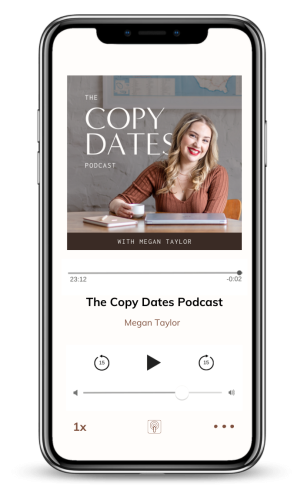
Check out these episodes from The Copy Dates Podcast to learn what you can do before, during, and after your launch to set yourself up for the most connection and conversions.
What to do before you launch
How to ask your audience what they want and refine your launch messaging before you start writing.
What to do during your launch
All the things you can do as you prepare to open your cart and after the offer is live to keep the sales momentum going.
What to do after you launch
How to collect data post-launch and use it to write even stronger launch copy the next time around.
Can I read your mind?
Frequently Asked Questions
It depends on your launch style, your offer, and how big you want to go. At minimum, most launches need a sales page, a handful of sales emails, and some kind of pre-launch buzz (even if that’s just a waitlist page). The full list — including checkout copy, order bumps, upsells, Facebook ads, and post-launch follow-ups — is what this guide covers. And if you want to skip straight to the pieces your launch needs, the personalized checklist tool will sort that out for you in about two minutes.
Give yourself at least 2-4 weeks before your launch date, more if it’s your first time. The biggest mistake I see? Leaving the sales page until the week of. Your sales page is the backbone of every other piece of copy you’ll write (emails, ads, social posts all pull from it), so start there. The launch copy guide on our blog breaks this down in more detail.
Absolutely — relaunches need just as much copy planning as first-time launches (sometimes more, because you’re updating existing assets while creating new ones). This guide covers both scenarios. If you’re doing a rebrand or significant offer update, pay extra attention to Steps Two and Three — that’s where the heavy lifting happens for relaunches.
Then don’t write all of it. Seriously. The personalized checklist tool helps you prioritize based on your specific launch, so you know which pieces are essential and which are nice-to-haves. And if you want to speed things up, our launch copy templates give you a fill-in-the-blank starting point for sales pages, email sequences, and more. You don’t have to start from scratch.
Ready to tick everything off the list?
You just read the full breakdown of every piece of launch copy you could possibly need. The personalized checklist tool figures out which ones you actually need. Takes about 2 minutes.