You just booked a new client. The contract is signed, the invoice is paid — now what? If your answer is "scramble to figure out what to send them," you need a client onboarding template.
A client onboarding template is a reusable set of emails, questionnaires, and welcome documents that you send to every new client after they book with you. It standardizes your process so nothing gets missed, your client knows exactly what to expect, and you look like the professional you are — without starting from scratch every single time. For online service providers especially, a strong onboarding template is one of the fastest ways to improve your client experience and protect your time.
Yes, building your onboarding system takes some upfront effort. But once you template it, it gets easier and faster every time you sign a new client. It's one of the smartest investments you can make in your business. I'm going to walk you through exactly what your onboarding system should include, what to send and when, and the mistakes I see service providers making over and over again that are costing them clients and money.
What Should a Client Onboarding Template Include?
Your onboarding template doesn't need to be complicated, but it does need to cover the basics. Here's what a complete onboarding system looks like versus what most service providers are currently doing:
| "Winging It" | Templated System |
|---|---|
| Manually writing a welcome email every time | Automated welcome email triggers as soon as payment comes through |
| Forgetting to send the questionnaire until 3 days in | Questionnaire link is in the first email — client fills it out before you even start |
| No contract, or sending one "when you get around to it" | Contract is signed before or during checkout |
| Client has no idea what happens next | Welcome email lays out the full process, timeline, and how to contact you |
| Scope creep because nothing was documented | Everything is in writing from day one |
A solid client onboarding template should include these core pieces:
- A contract — signed before any work begins (more on this below, because too many of you are skipping this)
- A payment system — ideally one that triggers the rest of your onboarding automatically
- A welcome/kickoff email — sent immediately after payment, with everything your client needs to get started
- An onboarding questionnaire — so you can collect the information you need to do your job well
- A welcome packet or resource hub — optional but valuable, especially for bigger projects
- A follow-up email — for when a client hasn't completed their onboarding steps
The specifics will vary depending on your service — a copywriter's questionnaire looks different from a designer's, which looks different from a VA's. But the framework is the same.
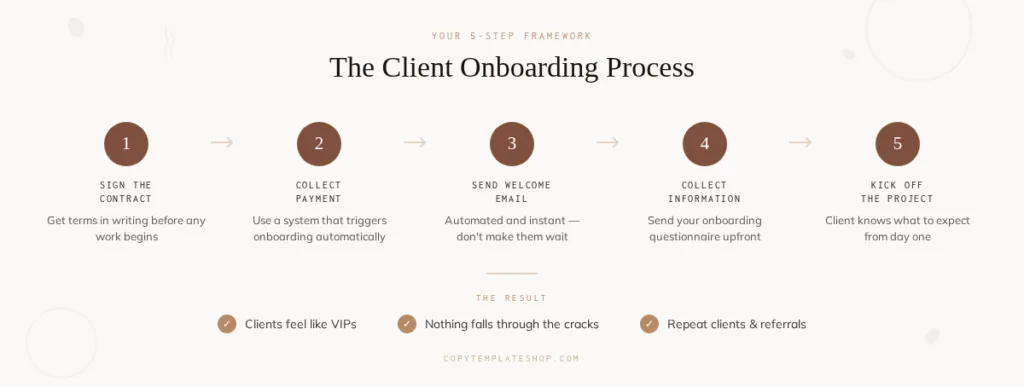
How to Build Your Client Onboarding Process (Step by Step)
Here's how I've set up my own onboarding process, and what I'd recommend for any online service provider who wants to stop winging it.
Step 1: Get the contract signed.
I cannot stress this enough. Before money changes hands, before you start any work, get a contract in place. For one-off projects, I have my terms of service baked right into my ThriveCart checkout — clients agree to the terms when they pay. For ongoing work and retainers, I send a separate contract before they even see an invoice.
If you don't have a contract template, The Contract Club has templates built specifically for online service providers. I recommend them to every service provider I work with.
Step 2: Collect payment.
There are a lot of ways to handle invoicing. You can send invoices through PayPal or Stripe, create your own custom invoices, or use an invoicing tool — whatever works for your business and feels professional.
I personally use ThriveCart to sell most of my services. Most of my services are productized, which means it's the same price for pretty much every client, so I don't need to manually create invoices. I just send them a checkout link, they take care of it when they're ready, and I can make the whole thing look really polished and on-brand. The part I love most is that everything that follows — the onboarding email, the questionnaire, the whole system — triggers automatically as soon as payment comes through. Your client doesn't have to wait for you to be at your desk. The process starts without you.
That automation matters more than you think. (I'll explain why in the mistakes section.)
Step 3: Send your welcome email.
If you really want to create a five-star client experience from the very beginning, I'd recommend making sure your welcome email is automated — meaning it goes out as soon as payment is confirmed, without you having to lift a finger. This is the first impression of what it's like to actually work with you, and it sets the tone for the entire project.
Your welcome email should include:
- A warm, clear confirmation that you're excited to work together
- The onboarding questionnaire link (so they can start right away)
- How to contact you during the project — your preferred communication channel, response times, boundaries
- If a kickoff call is part of your process, a link to your scheduling tool
- A brief overview of what happens next and when
Step 4: Collect the information you need.
Your onboarding questionnaire is where you gather everything you need to do your best work. The goal is to ask the right questions upfront so you're not chasing information halfway through the project.
What those questions look like depends entirely on what you do:
- If you're a copywriter, you'll probably need to know about their brand voice, their target audience, the offer you're writing for, and any existing copy or messaging they've used before.
- If you're a web designer, you'll want their brand assets (logos, fonts, colour palette), examples of websites they love, the pages they need, and any functionality requirements.
- If you're a virtual assistant or OBM, you might need access to their project management tools, a breakdown of recurring tasks, and clarity on which decisions you can make independently versus what needs their sign-off.
The format will vary too — some providers use Google Forms, others prefer Dubsado or HoneyBook, and some just send a well-structured Google Doc. If you don't want to pay for a CRM tool, Google Workspace gives you Forms, Docs, and Drive all in one place — which is honestly more than enough to run your entire onboarding system.
And if you go the Google Docs route, it doesn't have to look basic. You can create a really beautiful, branded questionnaire that feels polished and professional — the kind of thing a client opens and immediately thinks, "okay, this person has their stuff together." I love these fillable Google Doc templates for this — they show you how to design documents that look custom without needing any fancy software.
Pick whatever makes it easiest for your client to fill out thoroughly. I go into more detail on what categories to cover in the questionnaire section below.
Step 5: Kick off the project.
Once you have their questionnaire responses, you're ready to go. Some service providers schedule a kickoff call at this stage; others send a project timeline and dive straight in. Either way, your client should never wonder "what's happening next?" at any point.
Client Onboarding Email Templates You Can Copy
Here are two email templates you can use right now. Customize them for your service and your voice — these are starting points, not scripts.
The Welcome Email
Subject: You're in! Here's what happens next
Hey [Client Name],
I'm so glad we're working together — I can't wait to get started on [project type].
Before we kick things off, I need a few things from you:
Step 1: Fill out [this questionnaire / onboarding form] so I have everything I need to [do the work]. This should take about [X] minutes.
Step 2: If you have any existing [documents, brand assets, logins, content] I'll need access to, you can share them [here / via email / in our shared folder].
Step 3: [Book your kickoff call here / Expect to hear from me by [date] with your project timeline.]
If you have any questions along the way, you can reach me at [preferred contact method]. I typically respond within [timeframe].
Talk soon!
[Your Name]
The Follow-Up Email
Use this when a client hasn't completed their onboarding steps within 48–72 hours.
Subject: Quick reminder — I need a few things from you!
Hey [Client Name],
Just a friendly nudge — I still need your [questionnaire responses / brand assets / login details] before I can get started on [project type].
Here's the link again: [link]
Once I have everything, I'll [send your project timeline / book your kickoff call / start the first draft]. The sooner you can get this to me, the sooner we can get rolling!
Let me know if you have any questions.
[Your Name]
These two emails alone will save you hours of back-and-forth. I'm also working on a complete Client Onboarding Template Pack with every email, questionnaire, and welcome document you need — all done-for-you and ready to customize. Join the waitlist to be the first to know when it's ready.
What to Ask in Your Client Onboarding Questionnaire
Your questionnaire should be organized by category so it's easy for clients to fill out and easy for you to reference later. The exact questions depend on your service, but here are the categories most service providers need to cover:
- Business basics — What does your business do? Who do you serve? How long have you been in business?
- Project goals — What do you want this [project/deliverable] to achieve? What does success look like?
- Target audience — Who is your ideal client or customer? What are they struggling with? What do they want?
- Brand and style preferences — Do you have brand guidelines? What's your brand voice like? Any examples of brands or competitors you admire?
- Existing assets — What do you already have that I can work with? (Content, copy, analytics, login details, etc.)
- Logistics — What's your ideal timeline? Are there any hard deadlines? Any other team members I should loop in?
A few tips: keep it under 20 questions (any more and clients will procrastinate), use a tool that makes it easy to fill out on any device, and phrase your questions so they're specific enough that you get useful answers — not one-word responses you can't actually work with.

The Onboarding Mistakes That Are Costing You Clients
I've been running my own service-based business for years, and I've also been on the receiving end of other people's onboarding processes (some great, some not so great). These are the three mistakes I see most often — and the ones that tend to have the biggest impact on your client relationships and your bottom line.
Not automating your onboarding
Imagine someone just paid a four-figure sum to work with you. There was probably a lot of heavy decision-making and uncertainty that went into that choice. They committed, they paid — and then they get absolutely nothing for 24 hours because you happened to be away from your desk.
That's where buyer's remorse starts to creep in. They start second-guessing the investment. They start feeling uneasy. And by the time you do send that welcome email the next day, you're already on the back foot.
This is why automation is non-negotiable. Your welcome email needs to go out the moment payment is confirmed — even if there are personalized elements you need to add later. Send something right away so your client feels taken care of and can start on their side of the project. You can always follow up with additional details once you're back at your desk.
Operating without a contract
This one genuinely makes me sad, because I see it all the time — even from experienced service providers. Really talented people who are burning themselves out with scope creep and clients who take advantage of them, and it's because they didn't get a contract in place. They didn't protect themselves.
No contract means no legal documentation of what the project includes, when payment is due, or what happens if scope changes. That's how you end up finishing a project and not getting paid. That's how scope creep takes over and suddenly you're doing twice the work for the original price.
It doesn't matter how "small" the project is or how much you trust the client. Get it in writing. If you don't have a contract template, grab one from The Contract Club — they're specifically designed for online service providers and they're worth every penny.
Treating onboarding like admin instead of a client experience
Your onboarding process sets the tone for your entire project. It can be the difference between a client who's happy with the work and moves on, and a client who is so thrilled with the experience that they recommend you to everyone they know.
If you treat your clients like VIPs from the minute they sign that contract, that's what turns one-off projects into repeat clients — and repeat clients into a full referral system for your business. Your onboarding is the foundation of all of that. It's one of the smartest things you can invest in as an online service provider, because it pays off long after the project is done.
Frequently Asked Questions
What should a client onboarding template include?
A complete client onboarding template includes a contract, a payment and invoicing system, a welcome email that sends automatically, an onboarding questionnaire to gather project details, and a follow-up email for clients who haven't completed their steps. Some service providers also include a welcome packet or client resource hub with process details and FAQs.
When should I send a client onboarding email?
Immediately after payment is confirmed — not an hour later, not the next day. The moment a client pays is when they're most excited (and most vulnerable to buyer's remorse). An instant welcome email reassures them that they made the right decision and gives them something to do right away.
How many questions should be in a client onboarding questionnaire?
Keep it under 20 questions. Any more than that and clients will put it off, which delays your project start. Focus on the questions you actually need answered to do your work — not "nice to have" questions that you'll never reference.
What's the difference between client onboarding and a welcome packet?
Client onboarding is the full process — from contract signing through project kickoff. A welcome packet is one piece of that process: a document (usually a PDF) that outlines your services, process, timelines, communication preferences, and boundaries. Think of the welcome packet as the reference guide; onboarding is the entire experience.
Do I need a different onboarding process for every service I offer?
Not entirely. Your core framework — contract, payment, welcome email, questionnaire, follow-up — stays the same. What changes is the content inside each piece. A VIP Day questionnaire will ask different questions than a 3-month retainer questionnaire. Build the system once, then customize the details for each service type.
How do I follow up when a client doesn't complete onboarding?
Send a friendly follow-up email 48–72 hours after the initial onboarding email. Keep it warm and helpful, not passive-aggressive. Restate what you need, include the link again, and remind them that the sooner they complete it, the sooner you can get started. If you still don't hear back after a second follow-up, a quick voice message or DM usually does the trick.
Start Your Onboarding System Today
You don't need a perfect system on day one. You need a functional one — a contract, a welcome email, and a questionnaire that gets you the information you need. Start there, automate what you can, and refine as you go.
If you want done-for-you templates for every step of your onboarding process, I'm putting together a Client Onboarding Template Pack — join the waitlist to grab it first. And if you're still working without a contract, please go fix that today — The Contract Club is the easiest place to start.
What to Read Next
- Services Page Website Must-Haves to Win Over Dream Clients — Your services page sets client expectations before onboarding even starts. Make sure it's doing its job.
- How to Plan and Sell a VIP Day That Gets Booked — VIP days need their own onboarding flow. Here's how to structure the whole offer.
- Must-Have Website Pages for Service Providers — If you're building out your business systems, start with the pages that matter most.